Showing posts with label Suzy Kendall. Show all posts

Sunday, 30 April 2023

Don’t go down to the woods today… Assault (1971), Network Blu-ray


Now, here’s a thing, I had no idea that the composer Eric Rogers was no relation to Peter Rogers despite their working together dozens of times mostly on Carry on films, all but two had Eric’s scoring. Born in Halifax, Eric’s real name was Eric Gaukroger although he later hyphenated his surname to Gauk-Roger. As with Peter though, Eric diversified and this thriller was one of a number of a number of more “adult” crime thrillers they worked on including Vengeance (1971) and the excellent All Coppers Are (1972), also available on Network Blu-ray and also directed by Sidney Hayers.

I've started off with the Rogers as I’m always slightly surprised to find them away from comedy and especially Eric as clearly, he’s more evident in the films than the Producer. His score here very effectively contributes to the brooding menace and the sense of threat that powers the narrative. In terms of visual subtlety, Hayers is more efficient than inventive but it still works as an unsettling watch albeit one reliant on the male gaze and sexualised threat to femininity. Is it exploitation, probably but it’s well acted and sincere entertainment of its time…

We start off at a posh all-girls school as an array of period cars arrives to collect the slightly mature looking young women. If you like classic British motors, then you will not be disappointed with the films deployment of Morris, Triumph and Jaguar cars; art-teacher Julie West (the divine Suzy Kendall) drives a Morris Minor estate, Det. Chief Supt. Velyan (Frank Finlay) has a Morse-type Jaguar and Freddie Jones’ nasty reporter has a sporty model I’m yet to identify, possibly and MGA Coupe? That plus all of the Morris Minor Panda cars…

Shouldn't you be studying for your A-levels Lesley-Anne?

But the real story starts with one of the girls, Tessa Hurst (a 17-year old Lesley-Anne Down in her first starring role) taking a short-cut home through the woods which leads to her being viciously assaulted under the shadow of an electric power station, it’s unsettling to watch, a bit too voyeuristic for me, but thankfully not overplayed. The result leaves Tessa catatonic with shock and unable to talk as she’s taken in to care at a mental hospital by Doctor Greg Lomax (James Laurenson) who along with specialist Mr. Bartell (Anthony Ainley, famously The Master in Doctor Who after Roger Delgado).

The police launch an investigation under the command of Chief Super Velyan and Det. Sgt. Beale (James Cosmo, evergreen as he is and still performing!) and from this point on we will be introduced to a series of characters who are all a bit suspicious to some extent, the game of cat and red herring is afoot!

Obviously, it’s not going to be the lovely Julie who is as down with the kids as anyone in this rather odd school. Headmistress Mrs. Sanford (Dilys Hamlett) is so strait-laced it’s rather unlikely that she’s married to Tony Beckley’s creepy Leslie Sanford but that’s the point. Whilst she looks after the girls’ spiritual well-being he keeps an unblinking eye on their more earthy qualities, greedily eying them up in the playground or touching them up in the library (Janet Lynn, definitely over 18 and who played Carol Thatcher – no, not that one - with Robin Askwith in Cool it Carol! the year before).

Under suspicion: Tony Beckley, James Cosmo and Frank Dinlay

Then the situation gets even worse as another girl, Susan Miller (Anabel Littledale, aged 19) ignoring instructions and common sense, takes the same short-cut and this time the crime escalates to murder, with accompanying fleshy details. Julie, driving four other girls home, spots the missing pupil and drives her Morris into the woods, only to arrive just too late as she glimpses the killer, face lit by her red break lights in a demonic glow…

She cannot escape the image she saw nor explain it to the police and is all but laughed from the inquest when she describes her vision. Luckily for her Doctor Greg is on hand to support the very beautiful young woman in her hour of need, he has ulterior motive alright but is there anything more…? Certainly, of ill-intent is reporter Freddie Jones, playing a blinder as the grubby tabloid hack pushing for an angle and any salacious detail right to the point of pestering Julie at home.

The police assign Sgt. Milton (Patrick Jordan) to protect Julie as she paints the image she remembers and, in collusion with the reporter, puts a story in the papers that she can draw the face of the killer she recalls… it’s a very high-risk strategy and one we know will bring her into danger. But who will it be, one of the good guys or one of the obviously bad ones?

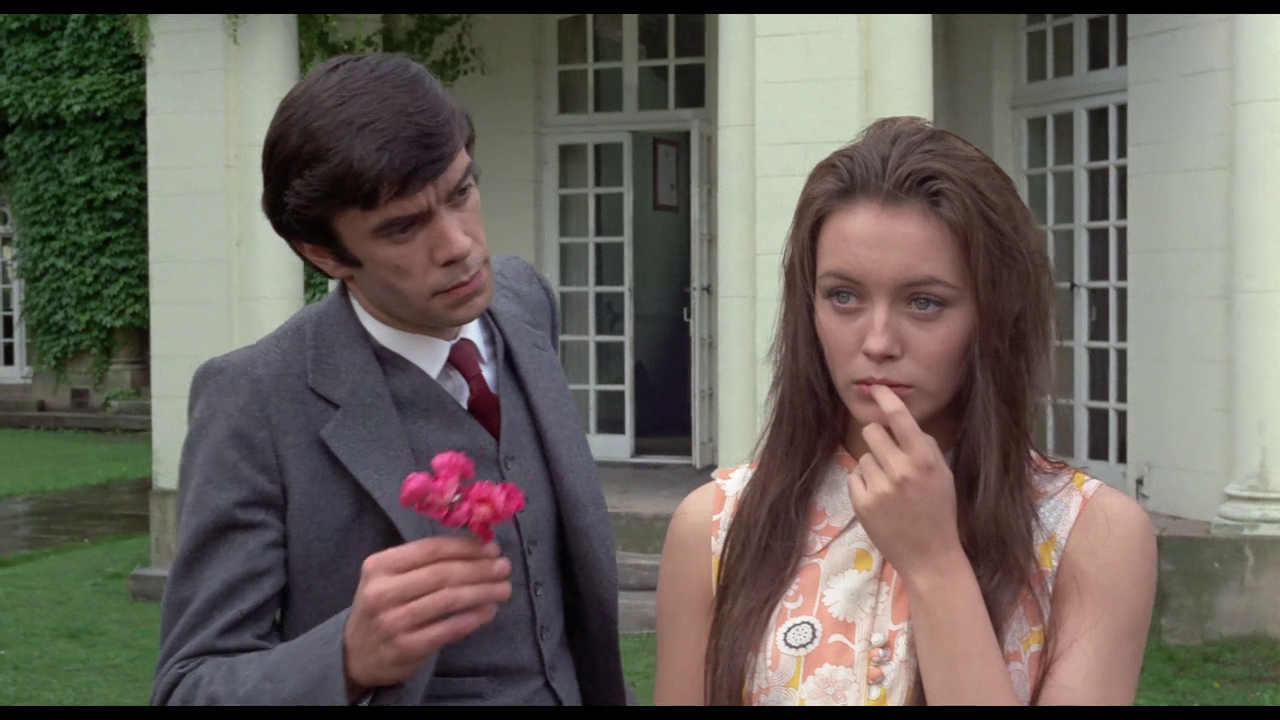
James Laurenson and Suzy Kendall

Dusty Verdict: Assault is an entertaining thriller that gets the job done with the aid of some very good performances especially from Frank Findley, who’s always so nuanced he could be one of the suspects… maybe he is, and Suzy Kendall who made a career out of playing female febrility, a Derbyshire Julie Christie!

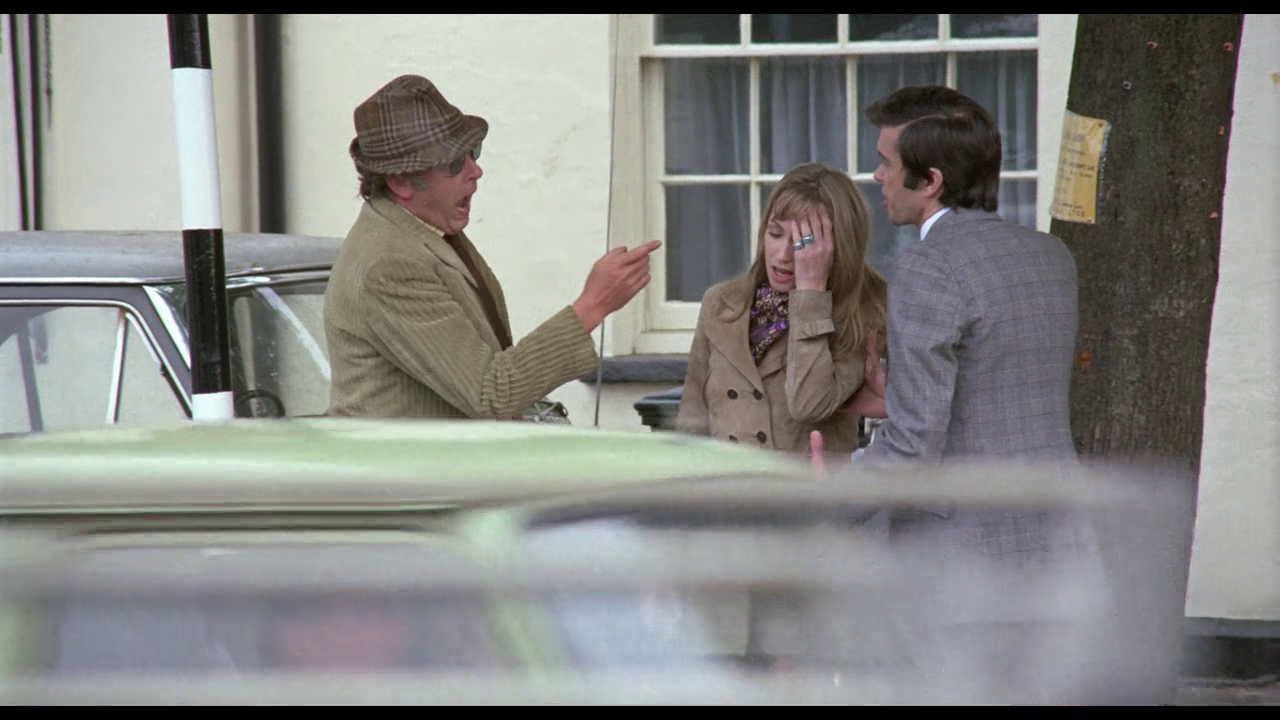
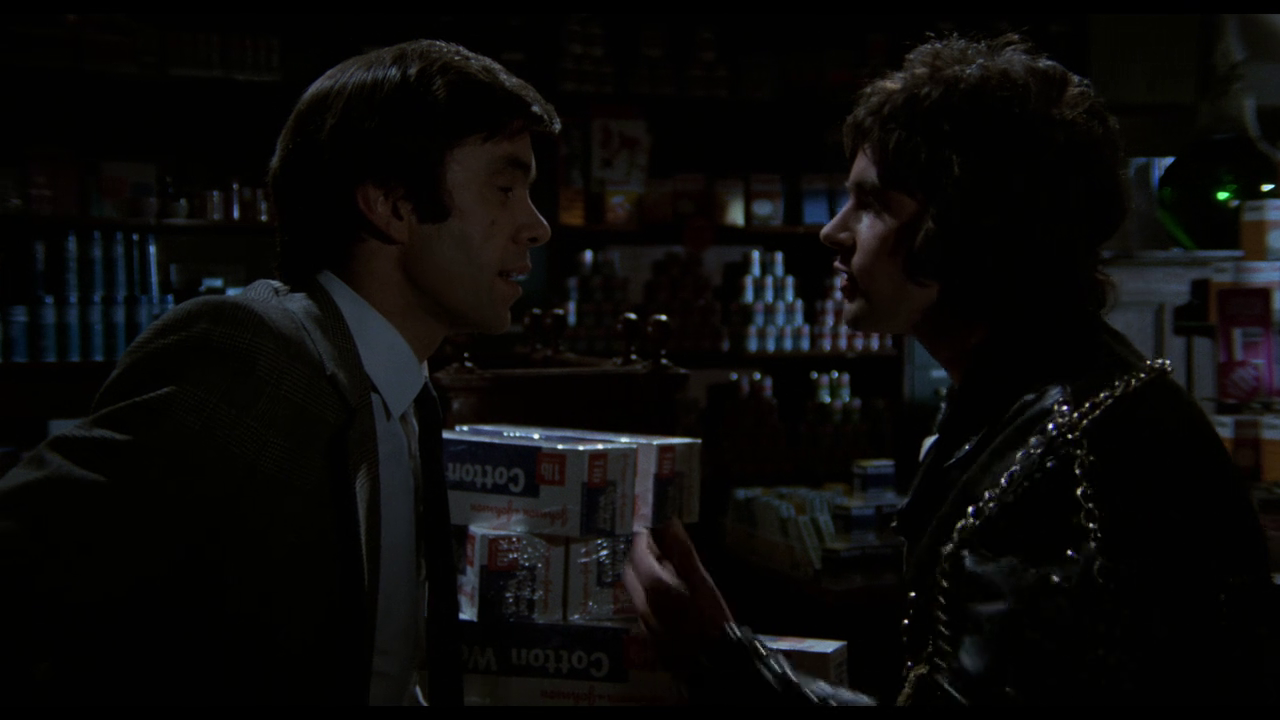
The set pieces are well executed and the villain is a genuine mystery for long enough… And, apart from the classy, classic cars, there’s some fab cameos including Mr David Essex as the leather-jacketed Man in Chemist Shop looking for help for his girlfriend’s nosebleed. It’s definitely not him…

You can order the Blu-ray direct from Network and at a great price, there’s so much on their website, you’ll probably come away with more than you budgeted for!

 
Freddie

The Headmistress' Husband is unsuitable for educational work...

David Essex!
 

The car section...
 
Classic cars...
Really Sidney? Cars and short skirts...
Morris Minor Estate with wooden trim: classic!
Jaguar
Morris Pandas
Is that an MGA Coupe?
 

Monday, 29 August 2022

Plenty of filling… The Sandwich Man (1966), Network Blu-ray out now


This is something of a city symphony from the fourth Goon and full of gentle charm to match the multiple locations across the capital, some of which have hardly changed, with others long since gone leaving no trace of “Swinging” London left. As a story the narrative is very thin and essentially just an excuse to see those sights as well as to allow dozens of guest stars to performing skits of varying levels of humour. The commentary from Producer/Cinematographer Peter Newbrook confirms that the entire picture was shot on location and that whilst they hit all their main targets, subterfuge was required to film certain scenes in the West End, given the unhelpful attitude of the authorities. This is a great advert for the vibrancy of the dirty old town and is a quirky near-classic!

Written by Michael Bentine together with Robert Hartford-Davis who also directs, great credit should also go to Newbrook’s cinematography and Peter Taylor’s editing. If it were nothing else, The Sandwich Man would stand as eloquent testimony to the time and place but it’s the guest stars that make it and only someone with Bentine’s address book could have pulled this off: Norman Wisdom, Diana Dors, Harry H. Corbett, Dora Bryan, Bernard Cribbins and Terry-Thomas… even Brian Cant pops up in a cameo. Delays also pushed them into the late summer/early autumn and the weather then became an issue. So, light comedy it may be, but we shouldn’t doubt the determination to get it made and it’s hard to keep sunny smiling when the cool wind come off the Thames…

It begins and ends with a street and some pigeons as the camera swoops down from the foggy East End sun to a row of colourful Victorian cottages. Out of the first comes Da Sikhars, two Indian jazz musicians played by Leon Thau (Ram) and Hugh Futcher (Gogi) in now-jarring brown-face – what was it about the Goons and playing Indians? Thau worked with Bentine in It’s a Square World before producing and directing Michael Bentine's Potty Time complete with legendary ant circus!

Dora and Michael

Next door along sees Roger Delgado emerge as Abdul, the carpet seller, followed by Burt Kwouk who defies racial stereotyping by jumping into an Italian ice cream van… just as cringeworthy today but in the context of 1966 all of a piece with a warm comment on the emerging diversity.

Next door to Burt is Horace Quilby (Bentine) pigeon fancier and sandwich man employed, for those of you from the 21st Century, to walk the streets of central London advertising services on cardboard signs slung over his shoulders, in this case Finklebaum & O’Casey Gents Bespoke Overcoats & West End Suits. His neighbour is played by the legendary Dora O’Brien, who takes a break from beating her carpet to inquire about his racing pigeon, Esmerelda, who is involved in a major race from Bordeaux to London. There’s a frisson between the two… the promise of more just as Horace’s feathered friend might bring him greater success in the sporting world of Columba livia domestica. 

Horace is a man of small pleasures, always looking on the bright side and enjoying people watching during his endless days of mobile advertising. He greats his neighbours and talks to a stunning young woman, Sue (Suzy Kendall, one of the faces of the era, star of Up the Junction and, in the seventies, many a Giallo film) who is having a falling out with her luxury car salesman boyfriend, Steven (David Buck). Steven arrives in one of many lovely period cars and there’s a great reaction shot from the bus queue as they look from side to side as the couple argue.

Super Suzy Kendall
Sue and Steven form the main thread with a running argument throughout the film exacerbated by the former’s job as a model being photographed by Bernard Cribbins who is, as always, a joy with more than a few improvised lines as he, literally, falls dahn an ‘ole in the grahnd being dug by David Lodge and his men. Da Sikhars also spend most of the film, erm, seeking to get to an Indian jazz festival and, Horace sees it all.

But the biggest hits come from the incredible list of stars. At the time they didn’t come much bigger than Norman Wisdom who plays a boxing vicar at a boys’ club near St Pauls. He has an “oirish” accent and does all his own stunts some of which are quite remarkable for a 51-year old. He’s positively Chaplinesque as indeed is Charlie’s son from his marriage to Oona, Michael J Chaplin, who plays a pavement artist during the Cribbins-Kendall-working men sequence. As with all of Chaplin’s kids, the most famous face in the world gives them a familiarity. Striking that we’re further away from this film than it was from The Great Dictator, Modern Times and even his classic period with Keystone, Mutual and Essanay.

Elsewhere we’re gifted with Terry Thomas as a scout leader trying to give Da Sikhars a lift before falling foul of a traffic policeman played by Ian Hendry, who shows his range as the comedically-tense copper on a bad day which culminates in his packing it all in when two cars collide (near Tolworth Tower on the A3, not central London) and the drivers are men in costume, a Kangaroo – who possibly jumped a red light – and a Polar Bear. Many of these sketches were drawn from Bentine’s It’s a Square World, they can be hit and miss but everyone contains those guest stars.

Norman nurses his bruises...

There’s a lovely sequence in Billingsgate Fish Market with Diana Dors debating the relative values of Doctor Kildare with Anna Quayle, and the camera keeps cutting to fish getting gutted, by Frank Findlay no less, as the women discuss TV operations… it’s well observed. We also get Abdul haggling with Sydney Tafler over exchanging one of his carpets for 30 pounds… of fish.

Sometimes the stars are in extended skits, Harry H. Corbett as a Stage-Door Keeper amidst a West-End chorus line rehearsal – lots of legs in that one – then Stanley Holloway as Park Gardener engaged in a running battle with Alfie Bass’ model yachtsman. Other times you blink and you miss them, and I was pleased with myself for spotting a young Georgina Hale as the motorcycle pillion rider who loses the bottom half of her leathers in Soho.

Still they keep on coming, Wilfrid Hyde-White as a rather confused Lord Uffingham, confusing pigeon owner Horace with a horse owner at the Hilton, Warren Mitchell as Gypsy Sid, reading tea leaves in a café and John Le Mesurier as the Senior Sandwich Man, Zebadiah, the almost mystical head of this peculiar group of workers.

Terry Thomas, what an absolutely spiffing idea!
There’s too many to mention and you’ll just have to make like Horace when he hits the tope of the stairs between Pall Mall and the Mall and stretches out his arms in appreciation of the Sun’s strengthening rays. I worked two summer seasons at a Butlins in North Wales and one of the comics there used to travel the whole north west coast and beyond. I asked him how he put up with so much travelling and he said just by enjoying the journey, people watching and making the most of each day.

I reckon Michael Bentine, and so many of his co-stars, knew that feeling all too well and there’s a Zen-like quality to this film. All will be well, just keep o keeping on and hope for the best… it’s the best you can hope for.

A quick tip of the hat to composer Mike Vickers whose music plays such a part in the film’s coherence and mood. The Sandwich man was well liked by those who saw it according to Peter Newbrook but it wasn’t the commercial success they hoped. Maybe the style was already slightly behind the times for the younger audience but this excellent transfer from Network brings to life again those locations and those ace faces.


The film comes with a host of special features:

·         Brand-new interviews with composer Mike Vickers, production accountant Maureen Newman, actor Hugh Futcher and draughtsman Alan Cassie

·         Archive interview with Michael Medwin

·         Archive commentary with producer/cinematographer Peter Newbrook

·         Theatrical Trailers

·         Soho Bites podcast with image gallery

·         Limited edition booklet written by Melanie Williams

It’s out now and you can order direct from Network – another hugely enjoyable winner and at a very reasonable price too!


Sunday, 25 October 2020

See Dudley Play… 30 Is a Dangerous Age, Cynthia (1968)


“… the most exhilarating part of it all was the music, mainly because I could indulge quite wantonly in all sorts of styles that were variously required for the different parts of the film.” Dudley Moore for the 1969 issue of the soundtrack 

One thing that gets my goat is the word “dated”. What does it really mean? Are people saying that just because something looks so much “of its time” that that’s a bad thing and also, shame on it for not having the foresight to take on board the sensibilities of future decades, for making the wrong choices about design and tone that would be just toe-curling in, say, fifty years’ time.

On a discussion board, one earnest fellow argued that Pink Floyd’s See Emily Play seemed to him to be “locked in the sixties, as psychedelic pop-rock…” but this is to view it in an un-historical way purely in the context of its relationship to a “now” it could never have seen coming. Syd’s Floyd were of their time – just as you and I are of ours – and you can still enjoy them for their musicality and the fact that they represent certain aspects of cultural style and musical development. Some of their choices may still be well regarded as they represent strands that not only influenced modern music but which also remain popular in of themselves. For instance, we still have indie guitar bands that play in similar ways even if they do not revere Syd Barrett, they’re making music that shares spirit and technique. 

Any view on “dated” is purely subjective but you can’t get away from the fact that music made in 1967 was for 1967 and not intended to be still fresh and timeless in 2020. Yet as an emblem of progressive rock from that period The Pink Floyd remain outstanding and, on that level, I’m glad their creations are “dated” if you see what I mean?

Suzy Kendall in a psychedelic scene

How does this apply to Dudley Moore’s 30 Is a Dangerous Age, Cynthia then I hear you ask? Well, very much so in terms of the style of comedy as well as the fashions on display in terms of clothing, humour and the whole mise-en-scène: it is undeniably of its time and therefore 52 years “dated” in relation to now. So, I watched it because I wanted a film of this vintage, one that showed Dudley Moore striking out on his own without Mr Cooke and, yes, because it featured the sublime Suzy Kendall, then married to Dudley Moore. I also watched because I have the soundtrack to the film on vinyl – a mono original pressing from 1968 – and because this film features The Dudley Moore Trio in one superb scene, playing live and loving it.

For those who always feel somehow sorry for Dudley Moore, and that he was in some way overshadowed by his more edgy partner, here I present is the case against: one, he was the better actor, two he was a top-rank composer and musician and three, Suzy Kendall! Moore was over-laden with ability and whilst this film is not a five-star work of genius it is likeable, stylish and still funny representing that Oxbridge comedy that, Beyond the Fringe – and Footlights – is still informing today’s comedians, writers and film-makers not to mention our, seriously un-funny, politicians.

Dudley and the Trio

As it happens, in the context of ability versus achievement, the film is very much concerned with the illusion of false targets. Dudley plays an aspiring composer, Rupert Street (which leads up into Soho and many a club and bar…) who plays jazz for a living and who is determined to tick off certain key life goals before he turns 30. We see him at the start of the picture trying to arrange his marriage date before he has even found a woman to propose to. The registrar, played by Frank Thornton (latterly Captain Peacock) throws him out onto the streets of Marylebone where he imagines a leggy dolly bird as his, much taller, bride.

Rupert works at Jock’s Box run by Jock McCue (the excellent Duncan Macrae!) but he has agreed to write his first musical if, that is, he can get the whole thing written in the few months before, you guessed it, his 30th birthday. He’s manged by Oscar (Eddie Foy, Jr.), an old stager with a can-do attitude and carrying the ever-present threat of “hoofing” and, whilst the pressure is on, if Handel could The Messiah in six weeks, surely Rupert can cobble together a musical. Cue a drift into a dream of bewigged musical and marital success with accompanying musical pastiche that Moore was so adept at performing. He arrives back at his flat still in character, reading a copy of his buddy’s Private Eye (Peter Cook being one of the founding fathers) now there’s something that has remained current!

The sublime Suzy and Dud

Moore was 32 at the time and had missed this target himself by two years when he married the sublime Suzy Kendall who co-stars in the film as his seemingly unobtainable and impossibly lovely next-door neighbour Louise. He meets her as she’s having a telephone argument with Paul (Nicky Henson… always so convincing in these parts!) the latest in a long line of men who’s looks promise far more than their morality delivers. Dudley’s smitten but surely out of his league… but he’s soon daydreaming of Louise as a bride and himself as a shorter Rudolph Valentino in The Sheik, ready to whisk her away to his tent for an in-tents experience, or maybe Fred Astaire, or a cowboy or a stock-car racer? 

Rupert’s imagination runs riot, but Louise invites him in for tea where he discovers that she is an artist who also teaches. He plays her one of his songs, which starts off with a fee upper class introduction before – in his head – they are transported to an ultra-modern discotheque, surrounded by appreciative scenesters as he bellows out an r n’ b (sixties style) song – The Real Stuff - and Louise go-go dances. Back in the room, they embrace and the improbable seems to be happening. 

But still there is Paul and an altercation outside Jock’s Box leaves Rupert with a broken arm – and you should see the other fella… - which is set in plaster at 90 degrees making it impossible to play. With the pressure mounting from impresario Victor (Peter Bayliss) and his mysterious backers the Honourable Gavin Hopton (John Wells who co-scripted) and Captain Gore-Taylor (Jonathan Routh).

Old Hollywood in Victor's pad

Slightly discouraged by Louise’s need to find her own career path and the ever-dwindling timeline, Rupert heads off to Dublin for inspiration, hundreds of coffees and some more fantasy. Finally, he meets a mysterious story teller (Micheál MacLiammóir) who tells him of The Golden Legend of Erin, an Irish fairy tale he visualises as featuring himself and Louise with Jock playing the evil baddie who tries to separate the lovers. 

He returns home and production starts but he now needs to find Louise who has seemingly disappeared in Birmingham. Will the lovers be re-united, will the play be any good, will John Bird turn up as northern PI with a Sam Spade fixation, Herbert Greenslade, years before Albert Finney in Gumshoe? Well, you’ll have to watch it to find out!

Dusty verdict: Released in March 1968 it already feels more like a 1966 film than a 1967 one, fashions and mood were changing so quickly and unevenly. It is a charming film that retains its humorous appeal thanks to both leads’ watchability and Dudley’s comedic restraint; he’s got more natural instinct here than many and his satire is always informed and gently effective.


His music is indeed among the best parts of the film from the delicious lines of Waltz for Suzy – proof enough of the couple’s affection even without the obvious chemistry between the two – to the quasi-orchestral Legend theme for the Irish tale. The score is an eclectic mix from the splendid folk pastiche of Madrigal to the big-band moods of The Detective, John Bird couldn’t have hoped for a more impressive musical signature. But what I enjoyed most of all was seeing Dud performing Rupert’s Romp, with his actual trio – Chris Karan on drums and Pete McGurk on double bass – at Jock’s Box. You can see them having an absolute blast and Dudley’s smile is the warmest and most genuine in the film and so is the watching Louise/Suzie… this is what they both knew he loved doing the most.

Joseph McGrath directs effectively and his supporting cast are superb with excellent work from Birkenhead’s finest Patricia Routledge and Larne’s Harry Towb as Rupert’s landlords as well as cameos from Clive Dunn as a Doctor (not butcher…) and Derek Farr as a TV announcer.

30 Is a Dangerous Age, Cynthia is sadly not available on digital release which is a shame as it’s a fine example of Dudley doing what he did best.