Showing posts with label Val Guest. Show all posts

Tuesday, 30 June 2026

Disclosure Daze… Toomorrow (1970), BFI Blu-ray out now!


I was very taken with Livy [Olivia], I thought she had everything going for her in this fresh bubbly way; she was worried about filming, but she got into it pretty soon.

Director, Val Guest

Within a decade Olivia Newton John would not only be telling John Travolta that he was the one she wanted but singing her way to Xanadu… but in the late 1960s the idea of her starring in a fantasy musical based on a hippy dippy plot was just a twinkle in someone’s eye.

This film wouldn’t last five seconds in the UFC of modern film criticism whether it was staged on the White House lawn or in a carpark in east London and yet… and yet we owe it to ourselves to try harder. Steven Spielberg recently had a go about reinstalling the “wonder” into the business of first contact but this film starts from the point of view that this is a given. The irony is that this was seen as a post-Monkees pre-fab four by, Don Kirshner, one of the men who pulled that disparate group of actually very talented musicians together (and Davey Jones who could dance and act…) and who’s co-creator, Bob Rafelson (plus his screenwriting and acting buddy Jack Nicholson) had released the cinematic suicide note that was the on-the-nose polemical anarchy of Head (1969) which is as knowingly cynical as this film is sweetly optimistic.

 “… we’re just too much, we’re TOO-morrow!”

Toomorrow sits somewhere between the Cliff Richard movies of the early 60s, those featuring Joe Brown, Marti Wilde and the Dave Clarke Five and the children’s TV of the early 70s… The Tomorrow People, Double Deckers and HR Puff ’n stuff. It doesn’t have the star power of finesse of A Hard Day’s Night or a Help! But it does have Olivia Newton John who by the time it was eventually released was on her way to solo success with early hits such as I Honestly Love You. Give Me Love and Take Me Home. She also has undeniable screen presence here and has more star power than her other three bandmates combined – that not to damn them just a mark of her presence.

James Bond film producer Harry Saltzman had entered into a three-picture deal with Kirshner and this was the first product of that with a script from David Benedictus which was re-written so much they never told director Val Guest. The latter did his best but, having not got paid, he launched an injunction shortly after the film was premiered and that was pretty much that. It has until this release languished on YouTube in a very low grade copy but, seriously. It’s a delight to see it restored for home media and given the attention it deserved as a period piece, a snapshot of the times and feelings and the cinematic birth of Livy.

It's not a question of being so bad it’s good, there are some genuinely impressive things not least the production quality, special effects and designs that under pin the science fiction aspects so well and a lively cast who you side with no matter how arcane their dialogue and the feeling of zero chemistry as a group. Film as history, history as film – it matters as much for the 1960s as for the silent era and this film, being just 40-odd years after The Jazz Singer is far closer to Jolson than Jackson, or Taylor’s The Era Tour… there’s a modern-day Olivia Newton John for you?

Now for the groovy precis and it’s tinged with the weary cynicism of an alien Alphoid called John Williams (I know how many more “coincidences can there be?!) played by the great Roy Dotrice, who has been watching Earth for three thousand years and frankly got a little bit bored of so little happening. But something has happened and it’s his colleagues on an orbiting spaceship who have picked it up, the first signs of something infusing the music of this world that actually makes them feel. Now, if this wasn’t so close to Stephen Spielberg’s empathy point I wouldn’t be so shocked… but whatever goes around comes around in All Toomorrow’s Parties from Close Encounters…, Xanadu to the present day we’re searching for the lost chord that will bring peace on Earth and to all alien cultures.

Galactic Control, who can only produce soulless electronica only without coherent beat, themes and, soul... are interested in a new sound being produced by Olivia and her pop band "Toomorrow", from sonic vibrations emitted by their special amplifier, a "tonaliser" - a processor attached to a Hammond organ that the Floyd would have killed for! Mind you, they had better songs! John Williams offers to help the group rehearse and record their ground-breaking sounds and we see them rehearsing in his Victorian pile in which he has transmuted various objects into a Revox 8-Track recorder and a more than makeshift studio.

The aliens kidnap the band and to get them to restore the loving feeling to their otherwise soulless space music try to take them home with them – they’d love to take them home – but whilst the band sympathises with this intergalactic lonely-hearts club, they have plans on their own planet. Everything will come to a head at a new bands night in Chalk Farm at the Roundhouse but will that be enough to restore harmony or will the guys have to be cool with living in space and never shopping in Granny Takes a Trip every again?

You’ll need to watch it to find out!

“If this antiseptic crew had really dared to set foot on the stage of the Round House during a pop festival, dressed up like canaries and singing their cute songs of love and tears, they would have been booed, quite deservedly, off it again."

The Monthly Film Bulletin 

Whatever the circumstances it is genuinely a thrill to see the Roundhouse as it was in the late 60s even if it’s not Syd’s Floyd, Soft Machine or The Pretty Things playing there. It’s more corporate these days… ticket offices and toilets… safer too! But the above reviewer is right in suggesting the disconnect between the location of counter-cultural grooves and this bubble gum pop. ONJ is a proper musician but she never stood in with Hendrix, the Incredible String Band or Steve Howe’s Tomorrow on that stage.

Groovy space-age features!!

Restored in 4K from the original camera negative and presented in High Definition

Audio commentary by pop music historian Andrew Sandoval

Tomorrow Night in London (1969, 5 mins): London swings – but gently – in this patchouli-permeated promo film for the world’s coolest capital

The Nose Has It! (1942, 8 mins): silly little Arthur Askey mucks about with hankies in this wartime winner from Val Guest - worth the price of admission on its own Playmates!!

The Guardian Interview: Val Guest (1998, 62 mins): Guest revisits his career in this onstage retrospective interview

The British Entertainment History Project: Val Guest (1988, 10 mins): candid reflections upon Toomorrow’s troubled genesis, accompanied by rare promotional images from the BFI National Archive

If I Could Turn You On (1969, 13 mins): US troupe Living Theatre rouse London hipsters at The Roundhouse with a provocative interactive performance

Chimp-Mates: Alice Goes Pop! (1975, 17 mins): Public Funk Chimpanzee No. 1 Alice picks up her sticks and kicks out the jams for a Children’s Film Foundation extravaganza

(2026, 12 mins): extra-terrestrial encounters of the groovy kind via this video essay by Celeste de la Cabra

FIRST PRESSING ONLY Illustrated booklet featuring new writing on the film by Matthew Hild, on Val Guest by the BFI’s Dr Josephine Botting and an essay by Jay Rathbone on manufactured pop groups, plus notes on the special features and film credits


Order direct from the BFI now man!!


Saturday, 27 February 2016

Hot off the press… The Day the Earth Caught Fire (1961)


This is not only amongst the very best of British science fiction but also a love letter to the British press or at least Fleet Street when it was Fleet Street. These are the men and women who search out stories in the public interest and who work unsocial hours risking life and liver in pursuit of the “story”.

The focus is on the great art deco Daily Express headquarters and everyone from an actual former-editor Arthur Christiansen (1933 to 57 – a long stint!) – who plays Jeff Jefferson the Editor – to the machine minders and the craftsmen who worked the hot metal presses day and night to deliver the news in a world every bit as 24/7 as our own. The Express and others was always open breaking news and only ever a plate make up, quick print run and rapid delivery by its fleet of vans, from informing its public of every key development: from press room to doorstep in mere hours all verified and proof-read (mostly).

So, when governments let us down and we screw up the planet, who can we rely on for the truth?

Edward Judd and Leo McKern outside the art deco splendour of The Express
The splendid new BFI restoration begins at the end with reporter Peter Stenning (Edward Judd) walking with weary steps down a parched Fleet Street. The Thames is empty of water and a heavy sun beats down on a parched West End. Stenning makes his way to the press room and finds his typewriter roller has melted he calls down to find the last copy boy working and begins to narrate his last and most important feature…

Cut to the press room as it was, full of care-worn, wise-cracking journalists navigating their way through the fast-moving events of a slow news day. Bill Maguire (Leo McKern) cracks wiser than most and is covering for a pal, Stenning, who has lost his way following divorce and an over-reliance on journalists’ ruin. Pete can barely string a story together and is rapidly running out of favours missing deadlines and many a point.

The press room - stories must have IMPACT!
Bill sends him off to the Royal Meteorological Society to investigate stories of abnormal sunspot activity; he tries to pull in a favour from an old pal and ends up gate crashing a meeting with the minister. He encounters a helpful and distractedly-curvy secretary Jeannie Craig (lovely Janet Munro) whose attitude to his rapid-fire banter changes once she realises he’s the same loudmouth who abused her on the switchboard. Stenning needs to work on his charm.

Stenning's charm initially fails him...
Later Pete attends a CND rally at Trafalgar Square – the film is very much about nuclear weapons and Wolf Mankowitz had originally written it after the UK’s first H-Bomb tests in the early fifties.  A fight breaks out with pro-bomb sympathisers – a bit like the next Labour conference – and as Peter hops on a TV news van he sees an unscheduled solar eclipse.

Eclipse over Trafalgar Square
Meanwhile the temperature rises to alarming degrees and Pete takes his son Michael to Battersea Park Fair taking him on the ghost rain much to the consternation of his new nanny – Michael’s mother has re-married and the future’s looking posh for the youngster. After dropping him off he finds Jeannie sunbathing and has another go at apologising… maybe it’s the weather but she’s warming to him.

The two share an ice cream and then nature takes another unexpected turn as a deep fog spreads rapidly up the Thames causing panic… On a limited budget director Val Guest makes the absolute most of his special effects and even with the unforgiving clarity of Blu-Ray, the scenes of London smothered in unnatural fog are still impressive.

The mist rises over Battersea
Yet it is the human element of the story where Guest most excels, with superb performances from Judd, Munro and McKern – three people facing up to the worst hoping for the best.

Guest shows some provocative shots of Jeannie in her bathroom before Pete arrives to be offered a couple of pillows and the bath… Theirs feels like a very real relationship for the time: she reluctant to give way not trusting the look of post-commitment in his eyes. But he is serious and the situation is getting far worse: if you were the only girl in the World and I were the only boy…

Things hot up
Whilst the Ministry keeps schtum the Express boys dig deeper and establish that not only has the Earth been knocked off its axis by two nuclear bombs exploded at the same time by Russia and the USA… but it has been nudged towards the Sun (not the odious newspaper, then called The Daily Herald by the way…) with no sign of stopping. What at first seemed to be a disaster is rapidly looking like Armageddon.

Meanwhile the authorities begin to clamp down on disintegrating society and water rations and near martial law are introduced.

What a scorcha!
The denizens of Harry’s Bar – a journalistic haven next to St Bride’s Church - gather to watch government pronouncements and to toast their increasingly-bleak futures. In spite of it all there is excellent interplay between Pete and Bill – the latter always hoping to set his pal back on course, both of them talking with the clipped precision you’d expect.

But Pete is getting himself focused not just on Jeannie but on The Story. His creative “Muscle memory” kicks in and he does his best for his readers, his talent and the wonderful new woman in his life.

The Express team wait for news
As his ex-wife’s new partner says as they prepare to escape to the country, “it all seems a bit silly now” – Pete wears the look of a man who felt that all along. Now he cares and you hope the crisis can be survived for this realisation to provide him more than short-term benefit…

Mankind’s last throw of the dice is to repeat the two atomic explosions in the hope of reversing or at least halting the planet’s drift. The minutes count down and then we return to the film’s beginning as Pete makes his weary way back to the Express. In the print room the crews prepare two front pages one for salvation and one for doom… Church bells hint at the former but you have to make your own mind up…

Parched Fleet Street
Dusty verdict: Undoubtedly one of the best British films of the period, The Day the Earth Caught Fire still stands up as a testament to man’s enduring humanity even in the face of such a crisis. The message is a simple one – take good care of the ecology and, enjoy yourself, it’s later than you think.

Leo McKern went on to have a long and illustrious career but his other co-stars were less fortunate, Edward Judd surprisingly never established himself as a regular leading man – a difficult temperament possibly holding him back (according to Val Guest) – although he got regular work and was a fixture of voice-overs in the 70s and 80s.

Janet Munro
Janet Munro was less fortunate, dying of heart failure at just 38 – gone far too soon.

The film is available on Blu-ray and DVD from Amazon and every home should have one!

Sunday, 3 November 2013

Soho sweet and sour… Expresso Bongo (1959)


A dip into the late fifties by way of comparison with Beat Girl… this film features a teenage Cliff Richard but still manages to carry enough Frith Street grit and Denmark Street guile to evoke the spirit of Soho. Setting all else aside, the film's use of genuine locations literally grounds its potential cheese in the shops, clubs and coffee bars that give Soho its timeless air: facia may come and go but the grind goes on forever... timeless good times.

Lisa Peake and Laurence Harvey
Based on the successful stage play of the same name and initially intended to feature one Tommy Steel taking side-swipes at the industry that birthed and abused him, it eventually featured the hotter, younger Harry Webb from Cheshunt, near Enfield. Just as Harry got a name change to Cliff so does his would be drummer, Bert Rudge, get re-branded as Bongo Herbert in this film: anyone doubting Expresso Bongo’s intent should check the surname…

Cliff Richard
There’s a wonderful cameo from Susan Hampshire playing a golly-gosh deb besotted with Bongo: “go on, say something in Cockney, apples and pears or something…” she pleads, sounding almost like Armstrong and Miller’s cut-glass chavy pilots…  This is the British laughing at themselves and joking about how easily they’re fooled, yet there’s also a harsher edge that ultimately leaves the successful on the slide and those on their uppers on the up.

Johnny extends credit to Kakky
Laurence Harvey uses his considerable skills to create a thoroughly dislike-able agent and serial abusers of goodwill: Johnny Jackson. We see him working his way down a Soho Street palming his best wishes to all whilst delaying his debts and wisecracking his way to nowhere… networking is only a payday away form not-working. He has a soft-spot for old man Kakky (Martin Miller) a former director... is he a vision of Johnny's future?

Sylvia on stage
His long-suffering girlfriend Maise, the sublime Sylvia Syms,  can sing and dance a bit (not enough for Johnny) and we see her do a rather risqué number at a “gentlemen’s club” surrounded by barely dressed chorus girls and the famed frozen semi-naked tableaux that allowed the strip clubs to avoid censure… It was a particularly British form of censure: allowing a view of naked flesh that was only permitted if it was motionless as if that somehow made it less real, less… overt. Only a public-school educated judiciary could work out the logic in that one.

It's "educational" so long as they don't move...
Never-the-less, this scene is still fairly frank for the time with scant coverings for the artistes and Miss Syms in the most revealing of costumes… Maybe the film’s musical status enabled them to treat this all in a jokier context than say the uncut version of Beat Girl?


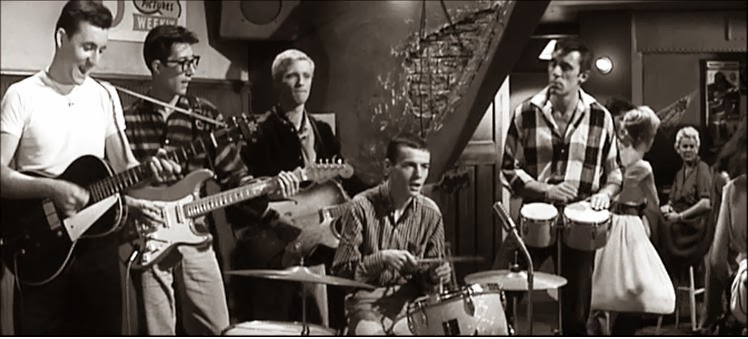
Anyway, soon enough the action moves to a suspiciously-spacious coffee bar basement where cheap-skate Johnny is taking Maise for some fish and chips. Their evening is cut short though when Johnny hears Bert sing as he "plays" his bongos backed by Hank Marvin, Bruce Welch, Jet Harris and Tony Meehan aka The Shadows (I’ve tried hard but can’t quite get the sound to sync with Cliff’s movements… by “hard”, I mean once…). In spite of Bert’s protestations that he wants to be a drummer (can’t he see The Shadows have already got a decent percussionist?) Johnny insists he can be a pop singer and that's the last we hear of Cliff's bongos...

Bruce, Hank, Jet and Tony... actor Barry Lowe on bongos
Cliff is ridiculously young but what catches the ear is how much reverb young Hank is using on his guitar, they sound a bit more rock n roll than they’re given credit for!

The newly christened Bongo meets Johnny at his parent’s flat and, in spite of motherly indifference and fatherly drunken stupor, a deal is struck and Bongo signs a contract splitting everything 50:50…

Hermione Baddeley, Lawrence Harvey and Cliff
Johnny kicks into gear and begins to hype his new property; jumping a ride on anything he can to increase his profile. He hi-jacks a BBC documentary being made by the actual Gilbert Harding, on Soho youth, to show off Bongo’s singing and then works his way onto the broadcaster's show to shout down the analysis of a pompous psychiatrist (Patrick Cargill) and a wet priest (Reginald Beckwith).

Denmark Street, London's actual "Tin Pan Alley"
Johnny suckers in the boss of Warwick Records, Mr Mayer (Meier Tzelniker), getting Maise to make a call there, pretending to be from HMV and Bongo’s debut single is soon shooting up the charts.

But Johnny’s biggest twist comes in forcing Bongo on the stage alongside Dixie (Yolande Donlan – director  Val Guest’s wife) for her triumphant UK comeback gig at the Dominion Theatre in Tottenham Court Road. He’s a smash and it’s not only Johnny that sees a way of hitching a ride on his rising star.

Cliff, speedos and Yolande Donlan
Dixie’s soon being more than motherly with Bongo luring him to her penthouse apartment atop the Dorchester Hotel – cue the shots of Cliff in speedos that were such an influence on a young and impressionable David Hockney.

But Dixie cares about the kid and especially his rotten contract and it’s dog eat jackal over the closing sequences as everyone fights over the spoils. In the end, you’ve pretty much given up hope for anyone in this sordid world but defeat brings out the best in some and a chance emerges for the film’s most likable and long suffering character…

The battle for Bongo
This uneven film interests and irritates in equal measure but has some good characters and dialogue – “I recognise the face but not the flattery” says Dixie to the ingratiating Johnny.  Harvey is good as the over-bearing huckster and has more than a passing resemblance to Jude Law; he went on to major film stardom and had an edge.

Sublime Sylvia
Sylvia Syms also excels in one of her patiently trusting roles: she’s said it herself but she didn’t always have good or lucky marriages in her films of this period. 

Mr Harvey on screen
Cliff is still learning the ropes but passes muster playing someone not unlike himself. More anodyne fare was to follow and here his role is earthed rather more than in Summer Holiday. Odd that his character appears to be pretty much a virgin, there’s no real love interest other than the motherly-predatory Dixie and religion is introduced as a way of selling a better image (a move I would guess he was later very embarrassed by).

"Go on, say something Cockney..."
There are also glimpse and you’ll miss them cameos from Burt Kwok and the aforementioned Susan Hampshire who would play alongside Cliff in Wonderful Life.

But this doesn’t feel like a “Cliff film” but a twisted ode to the dysfunctional pop business filmed in the streets at its very heart. In the end my star of this film would be London and in particular the surrounds of Soho as old as William Blake and alive still with the spirit of mischief.

Martin Miller, Sylvia Syms and Laurence Harvey
Dusty verdict: Worth watching just to street spot but Harvey and Sims make a good couple and you also have the young Shadows rocking in a way that convinced even Neil Young that they were cool! Beat Girl has the edge though if only for John Barry’s incendiary soundtrack, but the Soho scenes work better than the showbiz second half.

You can buy the DVD on Amazon but it's a bit of a collector's item thanks to the enduring appeal of Mr Harry Webb.
That is Wolf Mankowitz carrying the placard down Hanway Street...
Old man Kakky admires the artistes
Gilbert Harding plays himself