Showing posts with label Judi Dench. Show all posts

Sunday, 18 August 2019

Mind craft… The Third Secret (1964)


Let’s get this out the way from the start: the First Secret you keep from others, the Second Secret you keep from yourself, and the Third Secret is the truth. This applies to the everyday as much as the narrative in this smart psychodrama directed by the venerable Charles Crichton and starring Hollywood’s favourite Ulsterman, Stephen Boyd and the precocious Pamela Franklin – just 14 at the time of filming but carrying so much old emotion; a remarkable performance.

The film has elevated production values, with some glorious shots of the Thames side near Kew at Strand-on-the-Green where a lot of the action happens although when I say “action” I mean deep pondering set against the wide-grey waters and a poignant monochrome sky… Boyd is adept a brooding and carries an energy that suggests he is not only capable of dynamic action but also destruction and this much we see in one sequence where he trashes an apartment, accidentally making a small cut on the face of his young friend, Catherine.

Pamela Franklin and Stephen Boyd
The girl herself is fascinating as an actress and a character; not many teenagers could pull of the emotional conflictions she does and create the impression of violent damage as well as something deeply hidden… the “third secret” is one you can hold from yourself.

Catherine’s father, prominent London psychoanalyst Dr. Leo Whitset, is discovered fatally injured from a gunshot wound and as he dies, he whispers, "Blame no one but me." It looks like suicide and the coroner agrees but his closest patients tend to disagree. Boyd plays Alex Stedman, an investigative TV reporter haunted by demons and drink but still driven by a need to seek the truth. Catherine and he share a bond and she turns up at the studios to plead for his help in investigating what she is convinced is murder.

Stephen Boyd and Nigel Davenport
For a dynamic reporter, Alex certainly has a lot of self-doubt but I guess that’s why he was seeing Dr Whitset, but his need to restore his friend’s reputation is almost as important as the need to find his killer. Chief suspects look to be anyone of the Professors’ regular customers which just so happen to include Alex…

Aside from the angry, unpredictable journalist, there’s Alfred Price-Gorham (Richard Attenborough) who runs an elite art gallery, Sir Frederick Belline (the great Jack Hawkins) a high-level judge and Anne Tanner (Diane Cilento) a nervous secretary completely lacking in self confidence or resilience…The suspects are all impressive enough and what’s interesting is Alex flawed approach in investigating them. He’s no Sherlock Holmes even though he’s smart, solving the riddles that Catherine keeps on chalking on the walls of bankside near her home.

Richard Attenborough
At Price-Gorham’s gallery, Alex strikes up an encouraging conversation with his PA, Miss Humphries (Judi Dench in her first big screen role, before co-starring in the following year’s Four in the Morning). Her boss is a frustrated artist and trying to sneak his own work amongst the more established artists on show. Alex decides he’s an unlikely suspect based on his fear of elderly and opinionated customers… but you never know, he was working on a portrait of the professor.

Next Alex takes his “professional” interest in the case far too far in a one-night stand with the very vulnerable Anne Tanner (Diane Cilento) … it doesn’t end well and, as with his first interview leads us no closer to the chief suspect. It serves to show how “vulnerable” Alex is and how, if anything, he’s just another one of the four main characters who has lost their therapist.

Diane Cilento and Mr Boyd
The same is true of his eventual meeting with Sir Frederick who, whilst he undoubtedly has many things to hide, is not about to break down and deliver.

All of which leads us back to the Thames and the word games and pensive silences between Alex and Catherine… she in search of a father figure and he, possibly even unsure whether he’s a suspect. It’s a film that undermines the traditional string male lead and, whilst it meanders, leads us all down a false trail on purpose.


Dusty verdict: The Third Secret is well directed by Charles Crichton with some subtly stunning cinematography from Douglas Slocombe; if it feels less than the sum of its parts that’s possibly because there’s not enough meat in the character’s motivations outside of their internal crises. It’s perhaps too introverted for its own good.

The denouement is dramatic and might catch the unwary… it leaves a feeling of unease, something that could have been more prevalent earlier for despite itself, the film doesn’t have enough suspense or action.

Young Judi
That said, the acting is superb and none more so than from Pamela Franklin. There’s also a good supporting cast including Rachel Kempson, Peter Sallis and the ever-superb Nigel Davenport as Alex’s boss! Well worth seeking out now that it’s on Blu-ray.


Saturday, 13 December 2014

Thames-side story… Four in the Morning (1965)


This sparse film wears its influences lightly on its sleeve and, whilst it could easily be the back of Monica Vitti’s head the camera focuses on as she looks out Thames-ward, it’s Ann Lynn’s as she struggles to find her depth of feeling towards her lover. French new wave and Antonioni may well have been formative but this film has a very British feel all of its own.


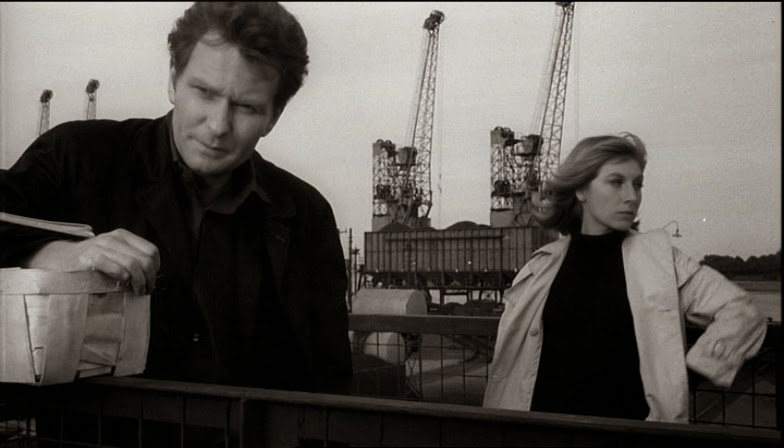
The film’s Thames locations have a muddy glamour accentuated by the somewhat under-lit camerawork of Larry Pizer: it had to be this way in order to cope with the contrast between bright morning sky and dark docksides. It’s a fascinating essay on London’s riverside showing a world just recently disappeared replaced from Wapping to Battersea by re-development, posh flats and office blocks… they only took down the old cranes in front of the power station a few weeks ago.

The characters are also particularly British (and Irish) with their quiet desperation: just about hanging on to hope through the distractions of sex, drink and see-through humour – which one of them will crack?

Ann Lynn
The emotion on show is also subtly under-scored by a debut film score from John Barry, none of his Bond pyrotechnics here or the swing of Beat Girl, just mournful jazz perfectly reflecting the dark waters and muddied motivations.

The film is focused on two relationships in crisis – four in the morning? – but there’s also another participant. The film starts abruptly with the discovery of a woman’s body: found  drowned in the Thames in bloated stillness on the shore out East. Throughout we slip to and from the two other story strands to follow the gruesome processing of this corpse, all the while trying to work out which one of the two women it might be… if either of course. We assume the narrative to be a flash back and the work of the river police, coroners and undertakers to be in the present.


The story moves downstream from the initial discovery to a nightclub near Chelsea in which a cabaret performer (Ann Lynn) is winding up for the night. She receives a phone call from a man (Brian Phelan) but doesn’t seem keen on meeting up with him.

Ann Lynn and Brian Phelan
He insists though and comes to greet her in the early morning light as she leaves the venue. The two look out over the river and smile: not strangers but not lovers either, not yet. They walk the riverside pathways and find a café for an early breakfast. There’s an uncertainty to them and they only abandon reserve when they decide to borrow a motor boat for a trip. There’s some superb footage as they sweep through Putney and round up towards the east end docks.


There’s love but she wants to be sure whilst he thinks sex to be the only way to demonstrate his feelings: to mean it he has to say it and the woman is chilled by his inability to explain himself.

Judie Dench
Elsewhere a young woman (Judi Dench) is near despair as her teething baby refuses to sleep. Her husband (Norman Rodway) is out on the tiles  with his best mate (Joe Melia), a joker who wants his friend to be the life and soul he used to be. The man takes them both back to their flat where they rudely interrupt his sleep-deprived wife.

Lads night out: Joe Melia and Norman Rodway
Here again the couple struggle to communicate as the lines between married life and a good time have not been properly drawn. He still wants to have fun but she feels the responsibility of parenthood and career more strongly. Is this just a phase of adjustment or have they drifted too far apart.

Talk but no understanding
Two women under so much pressure… will it be too much in the end?


The girl leaves and the man travel back West by tube and enjoy carefree moments chasing oranges across a bridge but it’s just a fleeting distraction and they will part at Aldgate Station (which has barely changed) leaving her to travel on alone.


The wife runs off but returns to find husband asleep… they talk about their lives and face towards their rivers front living room windows in neutral…as uncertain as ever.

The body is weighed, stripped and finger printed before being shut away in the mortuary… who was she? Do we know her?


Dusty verdict: Four in the Morning may tell a slight story but it tells it with style. Written and directed by Anthony Simmons it is a thought provoking film that lingers in the mind… The cast are superb and none more so than young Judi Dench. This was her first film, five decades before M, and her theatrical training is in evidence as her controlled expressiveness pulls the viewer in... we hope it's not her who succumbs but she's the one most believably at wit's end.


The film is available on DVD and is worth your investment: it's here from Amazon and here on Movie Mail.