Showing posts with label Brenda De Banzie. Show all posts

Sunday, 28 June 2020

Public interest? Passport to Shame (1958)


It’s all here! Nothing hidden… neither the sin… nor the shame!  Actually torn from the pages if the nation’s leading newspapers!

So screamed the American poster for this film and yet there’s more to it than box-ticking sexploitation. There’s an introduction from Robert Fabian, aka ‘Fabian of the Yard’, at the start, which makes it clear that it’s for public information not titillation; this is a film to show the horrors of sex work and the tragedies that fuel it and result from it. Frankly, I believed him – although this is the same public interest argument used by the News of the World – yet I’m sure that the filmmakers were sincere, especially given the quality of the cast, Brenda De Banzie, Herbert Lom and Eddie Constantine were not cheap or short of work. But there is also very little besides the high-octane sexuality of Diana Dors that you could class as salacious and, the thing is, Diana can also act, she’s a knockout and stands out among a quality cast.

The film’s story is also not to be belittled that easily – you can call it trite but the fact remains that people then and now have become trapped into prostitution and it is not the glamorous career of the sexually free but slave work operated by ruthless “business men”. The film hits as hard as it reasonably could in 1958 and is still entertaining, which is a good thing as it’s just been released on crystal clear Blu-ray.

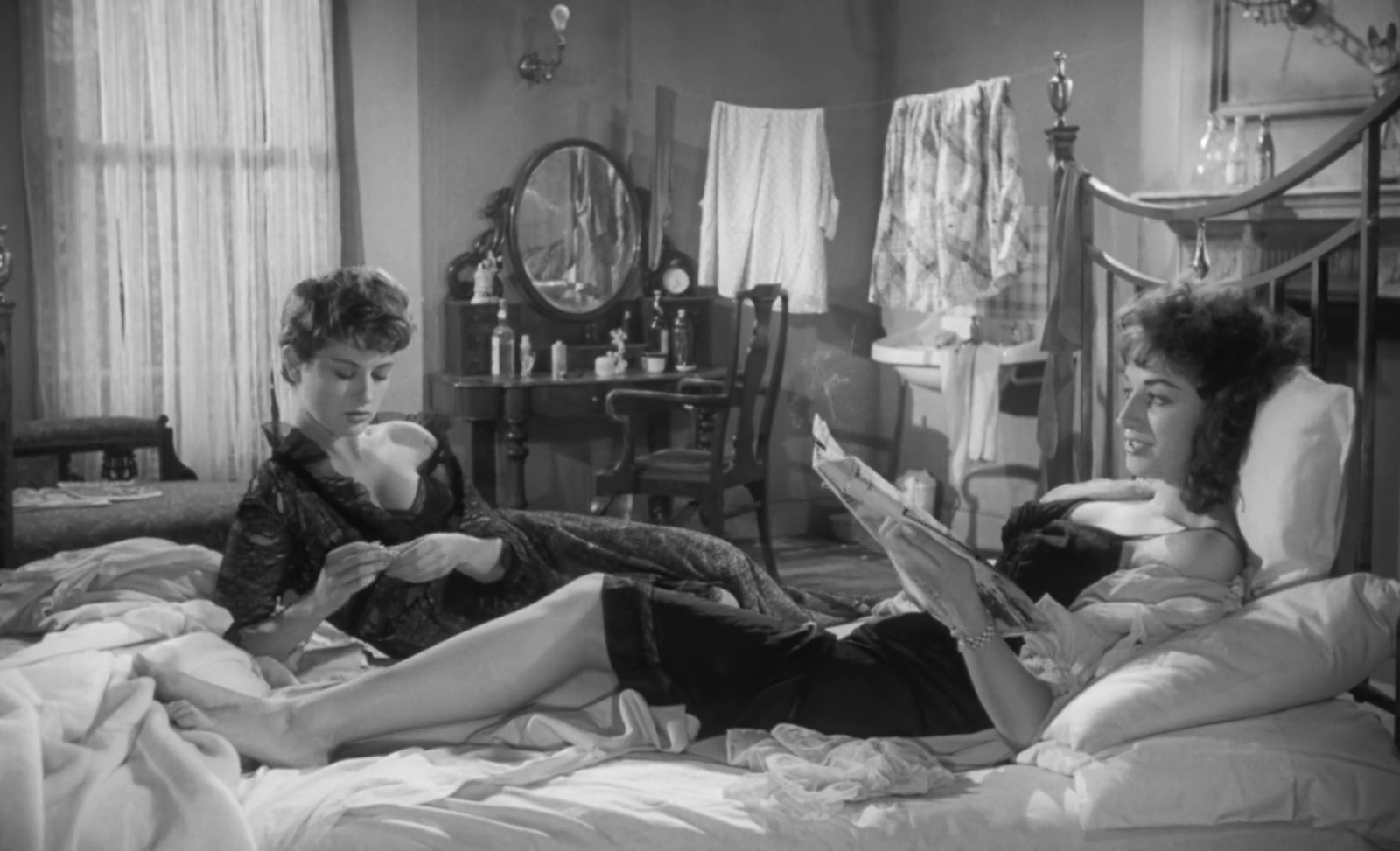
Odile Versois and Diana Dors waiting for the men...
I like the cleverness of the opening as those newspaper headlines are blown into the gutter in a busy London street where the camera moves quickly from person to person as littel scenarios are palyed out. A man sees a sgtunning blonde and follows up her body only to realise she's a streetwalker then he walks over to anothe man who is staring at a new taxi cab he is desperate to buy... a great way to introduce people who will become key characters as the titles roll.

Directed by Alvin Rakoff – his first film after working mostly on TV – the film is centred on the “business” operation of low-life crook with big ideas, Nick Biaggi (Herbert Lom, who always delivers, whatever the script). Biaggi’s little empire is based on extortion and pushing people into having to pay him back in kind for debts he creates. In Paris where a young waitress, Marie Louise 'Malou' Beaucaire (Odile Versois) is entraped by Nick's his right-hand woman, Aggie (the excellent Brenda De Banzie).

Malou (Odile Versois) looks on in horror as Aggie (Brenda De Banzie) "saves" her
She has the café owner take money from the till and accuse Malouf of stealing it as Aggie slips the same amount into her apron. She’s facing prosecution and so readily accepts Aggie’s seemingly generous assistance and the chance to come and stay with her in London.

Meanwhile, Johnny McVey (Eddie Constantine), a former Canadian soldier working as a cabby in London takes a loan from Nick’s company in order to buy himself a black cab, he’s stretched to the limit but he’s determined to make a success of the trade. On his first day with the new motor, just as he’s being congratulated by the tight-nit group of fellow black cab drivers, Nick arranges for his lads to drive a truck into the new cab, crushing the front and Johnny’s plans.

A friend in need? Lom and Constantine.
Nick is on hand though to play the nice guy and to offer to cover the cost of repair knowing that Johnny now owes him more than money, and that’s a big favour. That favour will be to marry Malou so she can get her citizenship. She’s been moved into Aggie’s apartment which, according to Reel Streets is Courtfield Gardens between Earl's Court and Gloucester Road in southwest London. Aggie’s rooms adjoin the neighbouring house, which is a brothel full of working women, one of whom is played by Jackie Collins, Joan’s sister.

Also to be found is Vicki (Diana Dors), Nick’s top earner and a woman resolute in the face of her situation and Nick’s violent treatment of her sister. Dors is striking in all the right ways and conveys the defiance of someone who knows what it’s like to be objectified and also manipulated. Her character’s sister has been the lever Nick has used to keep her working and she has been disfigured, forcing Vicki to carry on working for the man she so despises, to cover medical bills. For all the almost light-heartedness of the “girls” in the cat house, Dors’ intensity does more than anything else to ground this in a – dramatized – reality.

Diana Dors
Elsewhere you sense a fairy tale in the making as Malou and Jeff meet and go through the motions of marriage to settle their debt – or at least the first instalment of Nick’s unforgiving contract. Also present at the registry office is one Michael Caine who has just got married to one Anne Reid – uncredited bit parts for two actors who have never stopped working since.

Returning to our Johnny and Malou, the marriage may be fake but not perhaps their nascent relationship. But there’s a torture path to follow before anything can come from this as Malou finally realises what is intended for her and Nick pressures her to start paying him in kind on the streets of West London and to set herself up in Room 43 – the alternate title in the UK for this film. He has high hopes and sees her breaking him into the next level of high-class escorting but she wants none of it and refuses even though it increasingly means that she is not only surplus to requirements, she’s an problem in need of a drastic solution.

A marriage of convenience?
Robert Brown does well as Mike, Johnny’s friend who initially looks down on his relationship with what he sees as a common prostitute but, as the audience is intended to, he gradually comes round, especially as he befriends Vicki and realises there’s some heart underneath the figure hugging, peroxide display.

But there is to be no easy way out for these characters and the film escalates in tension as escapes fail, threats ae made and the ultimate penalty is going to have to be paid for some…


Dusty verdict: I gave this film the benefit of the doubt and it repaid me with some excellent dramatics from a decent cast. The locations are also worth it, parts of London where the only change in 60-odd years has been the frequency of external decoration and the tax-bracket of the inhabitants.

There’s also a heart-warming cameo from Joan Sims as Miriam, Phone operator in the taxi office and one Nicolas Roeg was the camera operator; he later went on to direct Don’t Look Now and many other modern classics. Passport to Shame is not on that level but, now, as a social document of the way this subject was viewed in my parents’ era, it is worth your time.

You can buy the Blu-ray at Amazon and all good on and offline retailers.

Fabian of the Yard
Mike bumps into Vicki during the film's credits and only comes to know her proper worth later
Johnny and Malou's dreams are revealed during the credits...
Nick is the one to use their hopes against them.
Still, he at least drives and Aston Martin
Lovely couple: Michael Caine and Anne Reid

Sunday, 30 March 2014

What the barrister saw… A Pair of Briefs (1962)


Sandwiched between the Royal Courts of Justice and Lincoln’s Inn can be found one of the most characterful pubs in London: The Seven Stars. An idiosyncratic ale-house for the legal profession and all who serve them (booksellers, publishers… journalists…) it is packed full of posters and photographs tracing the adventures of its landlady as well as the pub’s legal connections.


In the snug to the right – it’s all pretty snug to be honest – is a large poster promoting A Pair of Briefs featuring an angry looking James Robertson Justice and a scantily clad woman wearing a barrister’s wig and gown along with erm, a pair of briefs… see what they did there? OK… so what’s the excuse for watching what promises to be “Carry on Judging”? Well, it’s actually quite witty and, without doubt, there is a superb cast of British acting talent.

Mary Peach
Admittedly the film’s opening credits play up to the promise of the poster, we see a young woman, Francis Pilbright (the lovely, smiley, Mary Peach, who would later feature in the recently-recovered Doctor Who serial, The Enemy of the World), getting dressed for her first day in chambers. Miss Peach is indeed as shapely as her cartoon replication but in fairness this is the most we see of her as the narrative takes on a more dialogue-driven course (well, mostly…).

E-Type and Georgian house...
She leaves a splendid Georgian house and drives an E-Type Jaguar into London at the same time as we see a young man, Tony Stevens (Michael Craig) leaving a more modest Victorian town house on a scooter. Both approach Lincolns Inn and end up almost colliding… Tony is in the wrong but tries to convince Francis that he’s a legal hot-shot… so far so rom-com.

Micheal Craig and Mary Peach
He makes his way to his chambers where he finds he is about to be displaced from the window desk by a new starter who just happens to be the head of chamber’s niece. There’s much grumbling from the impoverished barrister who bemoans his lack of legal challenges and those juicy, highly-rewarding divorce cases, with his solicitor pal, George (Jameson Clark).

Then the new starter arrives and to no one’s surprise  it’s the E-Type driver… before hostilities are resumed Tony can’t help but admire the outline of her chasse (I know, I know…just getting into the spirit of the period…) whilst George is immediately disarmed.


Away from the Inns of Court, we see a well-dressed middle-age woman, Gladys Worthing (Brenda De Banzie) going into a plush Thames-side hotel and then emerging via the back entrance, considerably dressed down and hailing a cab with confident authority. She heads south and makes her way to a dingy maisonette where she encounters wise-cracking Sidney Pudney (Ron Moody) who she claims is her husband. Sidney appears not to recognise her and is shacked up with his “cleaner” Gloria (Liz Fraser) who finds his endless “as the monkey said…” riffing most amusing.

Liz Fraser, Ron Moody and Brenda De Banzie
Gladys is devastated and in her timid northern humility seems quite different from the woman at the hotel… she’s up to something but we don’t know what!

Back in chambers, George is despatched by Uncle Sir John (Roland Culver) to obtain more graphic evidence in a trial involving alleged improprieties at an entertainment venue in Soho.  George arrives to find himself plied with drink and given a close-up view of the acts on show… 

Bill Kerr, Jameson Clark and the great Amanda Barrie
There’s one Gale Tornado (Carry on stalwart Joan Sims), a dancer who performs with a snake (Amanda Barrie, Cleo herself…) and another who dresses as a maid (Judy Carne, later to become a fixture on Laugh In… see, I told you about the cast!). The club owner (Bill Kerr) ensures that George has a whale of a time and he reports back to Sir John with a brown envelop full of incriminating evidence against himself!

Judy Carne shakes a tail feather!
 Meanwhile, as Tony struggles on with civil engineering cases, Francis is delivered of her first proper brief, a case involving the denial of conjugal rights… Deciding that he can’t miss out on such a juicy case, Tony persuades George to give him the brief for the defence without letting him know that Francis will be his opposition: very bad form.

Francis and Tony square up for their day in court as we learn that the case will involve Gladys against Sidney… the strands are pulled together.

James Robertson Justice
The parties appear before the fearsome Justice Haddon (the fearsome James Robertson Justice… who was born to be a lord, m’lud) who grows quickly frustrated with both the inexperienced barristers, the dithering Gladys and the wise-cracking Sidney. Luckily, Gloria has been sent off to the pub and she quickly gets sozzled in a small lounge bar not unlike that in the Seven Stars…

Liz Fraser in The Seven Stars?
Gladys’ case is that she married Sidney in the War and their marriage licence was destroyed in a German bombing raid. For his part, as the monkey said to the hairdresser, Sidney denies everything and you scratch your head wondering what this is all about.

No spoilers: The court scenes are well done and as the mysteries of the case develop so too does the obvious rapport between Tony and Francis… who want to win each other as much as the case. Drunken Gloria makes a timely appearance and all is, almost, revealed…

Ron Moody
Dusty verdict: I won’t reveal the ending as a) it’s partly obvious and b) it’s mostly not…  A Pair of Briefs is ultimately a well written of slight, light comedy ideal for that undemanding nostalgia-watch you need at weekends or on sick days!

The cast are uniformly excellent and there’s a lot of energy from the Carry on cameos… along with the above you also get Terry Scott as a policeman and the recently departed Graham Stark as the man bringing the case against the nightclub.


It lives up to its poster promise and, if anything, is slightly more sophisticated than the image of the pantily-clad Peach at first suggests. She acts well and makes for a good match with the experienced Michael Craig: Britain’s own Doris and Rock?

A Pair of Briefs isn’t available on DVD and so you’ll have to wait for one of its regular TV screenings… another VHS I’ll keep in the dusty box for a rainy day…

Seven Stars on the right as Michael Craig scoots off

Saturday, 8 February 2014

London’s burning…Flame in the Streets (1961)


Notting Hill’s not what it used to be, not since Hugh Grant, Richard Curtis and Julia Roberts rubber stamped it as the capital of the culturally-cosy rom-com and, whilst there is romance, there’s precious little comedy in this frank depiction of multi-cultural London back in 1961.

Post war Britain had seen a mass influx of immigration from the former colonies and dilapidated Georgian Squares of Westbourne Grove, Bayswater and Knotting Hill had provided cheap, exploitative accommodation for many West Indian families. Tensions had run high as the run-down heart of former empire had struggled to assimilate so much change so quickly. The Noting Hill Riots took place in the late summer of 1958 and they saw the jailing of dozens of white men as well as the establishment of the Carnival aimed at bringing people together after all the hate.


But whilst society is now more integrated in many respects, race and immigration are scarcely less of an issue, and Flame in the Streets is still an important and resonating film and all the more remarkable for being over fifty years old.

Directed by Roy Ward Baker and screen-written by Ted Willis from his own play Hot Summer Night, the film focuses the key issues through the family of trade unionist Jacko Palmer (John Mills) – a decent man, protecting the equal rights of all his chapel members with a calm eloquence.

Johnny Sekka
Unknown to Jacko, his daughter Kathie (Sylvia Syms – how many great roles did she have over this period?!) is in a relationship with another member of staff at the school where she teaches one Peter Lincoln (Johnny Sekka) who just happens to be black.

In Jacko’s factory, he is supporting the promotion of a black foreman Gabriel Gomez (Earl Cameron). Gabriel is smart and a hard worker yet he has to endure racial abuse from white co-workers and there are senior union members who won’t countenance his appointment – not because they’re biased but because they “recognize” the problems this will cause… this is the running theme of the film: the whole pragmatic rationalization for racialism… it’s not you it’s the *situation*…

Earl Cameron and Ann Lynn
We’re given hints of the potential for mixed marriages with Gabriel’s home life with his white wife, Judy (Ann Lynn) who seems to have given up a lot to be with her man: living in reduced circumstances in a house stuffed full of immigrant families. There wasn’t adequate provision for the new Britons and many were abused by opportunist landlords.

Slum conditions and discrimination at work were one thing but racial violence is never far away with three of Gabriel’s Caucasian workmates on the lookout for trouble: goading him at work and where he lives as they travel in search of trouble.

Jacko prepares for the big union meeting at home with his wife Nell (Brenda De Banzie) and father (the brilliant Wilfrid Brambell) also a union man: there’s promotion ahead for Jacko too if he plays his cards right and long-suffering Nell dreams of a change of scenery…she has sacrificed much for her husband.

Sylvia Syms and John Mills
But things are coming to ahead at home to as Kathie gets spotted with her boyfriend and Nell finds out about the relationship. De Banzie acts up a storm as she attempts to deal with the facts…all her prejudice and fear surface as she imagines her daughter throwing away her future on a relationship that in Nell’s eyes will doom Kathie to a life on the outside.

Meanwhile Jacko is carrying the day at the meeting as he persuades the union that Gabe should be valued on his abilities alone and not his racial background. He argues fair and square but it’s not long before he is forced to face his own prejudices when Nell tells him of Kathie’s determination to marry the man she loves.

Nell and Jacko confront Kathie
Jacko takes a more rational approach than his wife and tries a subtler line, inverting the logic of the union meeting to say that this relationship should be judged on its potential utility and workability in the face of the accepted facts of racial intolerance.

He goes to speak with Peter directly and raises the same question putting the onus on him to justify the longer term discomfort any marriage will cause Kathie… it’s the gentlest form of intolerance wrapped up in reasonableness. Is Jacko being honest with himself – at least Nell admits her prejudice?

But it is a complex and difficult moment and you don’t lose sympathy with the family even when viewing them with modern sensibilities.

Mills, Sekko and Syms
Spoilers ahead: Events take a dramatic turn for the worst as the white gang brings violence to the bonfire night celebrations and there’s a riot going on pulling in thugs from both sides as well as the good guys… a riot of their own.

The spell is broken by the arrival of the police and as Gabe gets pushed into the fire. Pulled out by Peter and Jacko you hope for his recovery and that, somehow, this will be the start of the move towards reconciliation.

The film ends as Peter and Kathie walk back home with Jacko and Nell… ”if only it were that simple” said one of my companions but the ending gives no guarantees.


Dusty verdict:  A quite stunning period piece that deserves wider recognition: this is Britain starting to face up to itself barely a decade after the Windrush brought the first immigrants across from the Caribbean.

John Mills leads a superb cast by example with special mentions to Earl Cameron and Ann Lynn whose love and mutual support hopefully lead the way.

Flame in the Streets is available on an apparently less than satisfactory DVD in the UK although the US edition (which I watched) does proper justice to the CinemaScope aspect ratio.