Showing posts with label Ian McShane. Show all posts

Sunday, 26 February 2023

Get Ollie… Sitting Target (1972)


There was clearly something in the air in the early seventies for British Films, and it wasn’t just budget film makers cashing in, but some of the biggest producers with mainstream stars, Michael Caine’s iconic gangster in Get Carter (1971), Nicol Williamson returning to Liverpool in The Reckoning (1970), and even Richard Burton in Villain (1971). There was clearly a public fascination with the men of violence, to almost quote Peter Walker’s Man of Violence (1969), and the arrest of the Krays together with changes in film censorship meant that sex and hoods and rock n’ roll were splattering screens a lot.

It was only a matter of time before Oliver Reed got caught up in things and he’d had some form as had Ian McShane who was with Burton in Villain, but Ollie was playing nihilistic hard men even as far back as his threatening turn as leader of a wayward, Weymouth biker gang in The Damned (1962). In truth there was always something about Ollie, a feeling of barely suppressed ferocity, menace and a capacity for violence. Now that’s all acting my dears but you wouldn’t really be that surprised if Mr Reed could handle himself.

He starts this film in impressive form, working out in his cramped cell and looking very much like a caged animal. His character Harry Lomart is doing time for armed robbery which resulted in him killing a guard, who, according to Harry, should have just stayed out of the way. He’s a career criminal used to the risks and the rewards of his profession as is his neighbour Birdy Williams (McShane) who was on the ill-fated job with him.


Jill St John and Oliver Reed

Today Harry gets a visit from his wife, Pat (Jill St. John who appears to be dubbed by an unknown English actor, which is a shame), who hasn’t seen him since the trial. Harry loves Pat and she is the thing that keeps him going through the long stretches. Something has however changed, and she is tired of waiting, especially now he’s in for a long stretch and wants out, especially as she’s seeing another fella and is pregnant… Harry smashes the reinforced glass between them and tries to throttle her and it takes three guards to pull him away.

He's sent to solitary for weeks bashing himself the walls and swearing revenge… by the time he gets back to his cell he’s ready to break out and so is Birdy. They hatch a plan with wheeler-dealer MacNeil (Freddie Jones, who is always such good value) and, with the aid of a bent screw played by Mike Pratt, they make a daring escape, just about managing to scale the walls in time to drop to their freedom a passing lorry set up by MacNeil.

Ian and Oliver on the run

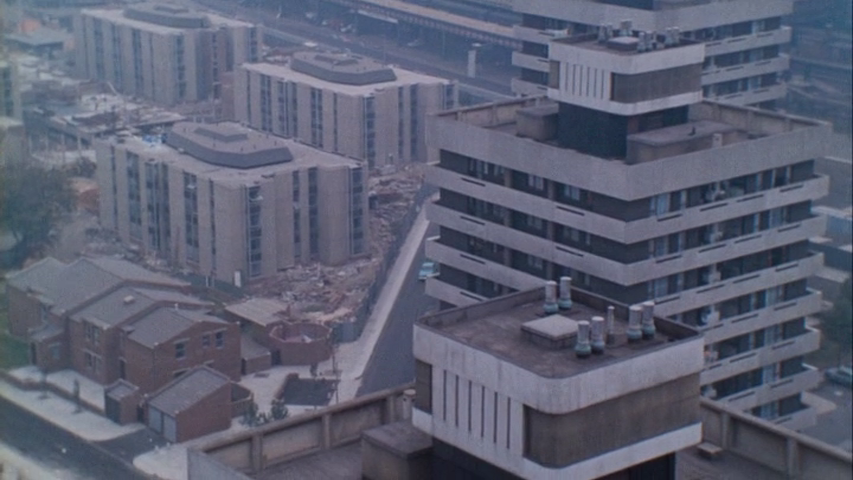
Birdy wants them to lay low but Harry’s a man in a hurry and after obtaining a gun sets about stalking his wife even though the police, led by Inspector Milton (Edward Woodward), are keeping on her home at the top of a tower block in the Winstanley and York Road Estates, Battersea. Despite all their efforts, Harry catches Pat unawares and, despite the intervention of Milton, who he almost throws over the balcony, he has to flee as the sirens start and, in a surreal sequence, he evades two motorcycle cops dodging among the sheets and the washing.

From this point on it’s a two-way game of cat and mouse with the police after Harry and Harry after Pat, with Birdy’s help, Harry plans to get hold of their hidden ill-gotten gains and to use this to secure his escape but things begin to get complicated with former allies quickly turning into foes as everybody tries to “deal” with Harry…

Dusty verdict: Directed with purpose and intensity by Douglas Hickcox Sitting Target is a very effective thriller which matches some of those hyper-violent crime capers for moral force and a script with more than one twist in its tail. For thos eof you who love period locations it's also a treat and feels very much a part of the London I almost knew... talking of which, Hickcox directed Les bicyclettes de Belsize (1967) which mapped out Hampstead and north west London just as well: he knows how to film location.

Jill St John and Edward Woodward

Of course, you can’t argue with the leading cast members and we even get legend, June Brown as the Lomart's Neighbour. In the end it’s Oliver Reed who carries the film’s most violent and tender moments, it’s quite something to see.

There’s also an excellent score from Stanley Myers which features synths and hard-edged jazz which perfectly captures the fast-moving action and the fierce emotions in a film which for all it’s violence, is as much about relationships and love as anything else. Myers’ score was released by Finders Keepers Records in 2007 and is, of course, now very collectable!


Tuesday, 28 August 2018

And one can smile and smile… Villain (1971)


I had no idea that Dick Clement and Ian La Frenais had been such prolific producers of feature films prior to their career in TV sitcoms. I grew up in time for Whatever Happened to the Likely Lads, Porridge and then Auf Wiedersehen Pet, but it’s only latterly I’ve caught their films such as To Catch a Spy (Kirk Douglas and Marlene Jobert spy caper), the magnificent Otley (Tom Courtney and Romy Schneider Notting Hill spy caper) and Jokers (Michael Crawford and Oliver Reed crime caper…). These films are patchy but ambitious and attempt to create very British products both in terms of location and humour.

With Villain they turned their sights on real crime and the huge impact celebrity criminals like the Kray twins had on British society even after they had both been locked up for good. They enlisted Richard Burton to play a crime lord along their lines, this one apparently brought up in the East End via South Wales with an accent flitting about somewhere between the two. In all other respects Burton is perfectly believable as the hardman with a soft spot for his mum and young Ian McShane. For the period it’s perhaps a juxtaposition to have a gay-hearted gangster but Ronnie’s sexuality was never a barrier to his free expression of violent intent.

Wolfie and Vic
The film’s a bit coy on the men’s relationship, concerned with Burton’s believability perhaps and a more explicit sex scene was cut over concern with audience reaction. The man himself took it in his stride telling McShane that he reminded him of Elizabeth: it may have been the hair perhaps?

Interestingly, the story was based on the book Burden of Proof by James Barlow, and a treatment by the American actor Al Lettieri, a 'tough-guy' in films such as The Godfather and who had actual connections with the New York Gambino Family. This coupled with some crisp dialogue and strong performances – what a cast list - ads a level of believability that leaves this film not that far behind the more stylised Get Carter and the under-rated The Reckoning.

Burton is Vic Dakin, master of hard-won turf in the East End – the location shots are a great window on those streets 48 years ago – and is coolly in control using violence to control the streets and anyone unfortunate enough to descend into his demi-monde. The opening sequence shows a well-to-do business man being violently taken to task and ending up dangling from his Knightsbridge window ledge with his girlfriend in hysterics.

Gerald looks to make new connections with Wolfie's friend Venetia
Vic’s got his fingers in many pies and runs parties at which the supposedly well-to-do can be entertained with and then blackmailed. One MP, Gerald Draycott (a nervy-pervy Donald Sinden) apparently based on Lord Boothby, has a weakness for younger girls and Vic is only too happy to oblige so long as Gerald scratches his back too.

Vic’s left-hand man is Wolfe Lissner (Ian McShane) who has a way with the ladies and procures the required talent. Wolfie’s smart and does what he must but his attempt to lead a life of his own with girlfriend Venetia (Fiona Lewis) is compromised by his being the apple of Vic’s eye too, still, he just about manages the balance.

Vic’s other henchmen are well cast Tony Selby, cockney-dubbed as Duncan, Del Henney – always believable in these roles - as Webb and John Hallam as Terry. You wouldn’t want to cross any of them.

Del and Tony
Out to catch them is Detective Bob Matthews (an impeccable Nigel Davenport) and his partner, Sergeant Tom Binney (Colin Welland); men who are from the same backgrounds but who chose a different path: whilst the villains hang out in strip bars and West End flats, plod tends their gardens in suburbia. The interplay between Vic and Bob (oh yes!) is a joy to watch with Burton and Davenport clearly relishing playing two sides of the same coin.

Vic has always relied on his mother to keep whatever sanity he has and, whilst she seems oblivious to his profession, Mrs Dakin (Cathleen Nesbitt) is of failing health and this starts to undermine her son’s judgement. He gets approached buy a man called Brown (James Cossins), a disaffected employee with secrets to sell concerning the payroll where he works but this is on the patch of rival boss, Frank Fletcher (T. P. McKenna).

Colin Welland, Nigel Davenport and Ian McShane
Against Woolfie’s advice, Vic meets with Frank and his nervy, hypochondriacal right-hand man Lowis (an unsettling and febrile performance from Joss Ackland) and eventually agree that the deal is just too good to miss.

If the plot has one major flaw it’s that these two bosses would get involved in the actual robbery, especially given the power Vic wields in the straight world… but, as his mother passes away and he becomes emotionally, as well as physically-dependent on Wolfie, he is intent on proving himself.

Will the job go as plan and will there be honour amongst thieves? Events play out with well-crafted action sequences, all shot on rugged locations in London which looks impressively careworn in 1970 as the cops and robbers’ career around in top of the range Rovers.

Joss Ackland, TP McKenna, John Hallam and Richard Burton
Dusty Verdict: The film makes some interesting points about criminal charisma but ultimately falls short of the class of say The Robbery or Get Carter. That said, Burton is eminently watchable – if not listenable – and carries the right menace to the end. There’s great support from Ian McShane – what a career he’s still having – he manages to make Wolfie a sympathetic schemer who’s just wheedled himself in to Vic’s world too deep to escape the man’s control and his – now unwelcome – passion.

Fiona Lewis is, as always, highly-watchable – the very model of a theatrically-trained, modern player amongst so many greats of the previous generation. It is a superb cast throughout. Plus, there's great motors, lots of them; Jags, Rovers, Fords... all high performance and driven at speed! Yes, I am shallow.

Fiona is highly watchable...
Victim’s breathless ending leaves open the question of whether right is might and this – as ever – remains pertinent; there are still Vic Dakins out there and not all, necessarily, in the business of crime…

The film pops up on Talking Pictures and on a 2007 Studiocanal DVD available from Amazon etc.