Showing posts with label Edward Judd. Show all posts

Sunday, 11 February 2024

Hostesses to fortune... The World Ten Times Over (1963)


It’s a mystery to me why this film isn’t better known. It not only fits in with the early-sixties “kitchen sink” classics like The L-Shaped Room, Victim and A Taste of Honey, it also has Soho Film credentials with some atmospheric locations captured along with the nightclub culture of the time. The narrative is so well constructed and there are definitely traces of French new wave but also the work of Antonioni certainly in the ways it captures the communication dynamics between men and women especially in one sequence in which we alternate between June Ritchie’s character not connecting with boyfriend whilst Sylvia Syms’ similarly fails to touch her father’s empathy centre.

The performances are so committed too especially from Syms as Billa (Sybilla) whose rage at her father, also well observed by William Hartnell, is sometimes hard to watch. There’s no meeting of minds as Billa tries to reach out but Dad is too intellectual and analytical to let her in. His idea of a day out is a lecture in the evening – juvenile delinquency, he’s a teacher – with an afternoon of Coriolanus at the Old Vic, anything to avoid actually spending time with his daughter, alone with themselves. Even if this is verging on cliché, Bill and Sylvia make it work really well, his still waters running so deep it takes her almost the entire film to get a rise out of him. Both as stubborn as each other and set in their rut only that’s not going to work as Billa has reached a crisis…

June Ritchie is not impressed.

June Ritchie I also find very compelling as Billa’s flat and workmate Ginnie, a young woman of restless energy who still hasn’t established her full sense of self. She’s impulsive, stubborn and unwilling to conform. Her boyfriend, Bob Shelbourne is played by Edward Judd who might be the only one slightly miscast as a spoilt and uncertain “mid-30s” nepo-baby, working in a senior position for his overpowering father, (Francis de Wolff) who controls his private life as much as his work having “arranged” his marriage to the prim Elizabeth (Sarah Lawson). Judd is indeed a little mature and rugged to play this naïve role and sometimes we don’t quite believe his motivations in risking everything for a 22-year-old “hostess”.

Ah, now there’s a word and it is, like other elements in the film, “coded”. Both women work in a nightclub as hostesses who are paid to drink and entertain the gentlemen who go there. There’s music and a compère played by Davy Kaye and lost of mostly middle-aged men eating and drinking with bored younger women… it’s not quite a “clip-joint” but the inference is certainly there that companionship can be bought and extended to a hotel or other external venue…

Written and directed by Wolf Rilla, perhaps best known for Village of the Damned (1960) an adaptation of John Wyndham’s classic sci-fi novel The Midwich Cuckoos (1957), the film is probably the earliest example of a lesbian relationship in British film although the coding is fairly deep on this one. Talking years later, Syms said she went as farm as she could to emphasise the love Billa has for Ginnie for as far as she was concerned that was what this was. There had been films with homosexual overtones before, Syms was in one of them, Victim with Dirk Bogarde, but as with the Victorian law banning only male same-sex relationships, women’s sexual attraction to women was largely ignored in this country.

Dignity Mr Judd, dignity...

Both women are let down by their men, and professionally, Bila, seems contemptuous of her clients. Ginnie is more easy going and she seems to be prepared to play along with her rich man although perhaps she is conflicted by her ultimate lack of feeling for him. She’s coasting along on the surface of sincerity and kicking back especially when Bob takes her to his father’s office for a “discussion” about finding her work so their relationship is more acceptable. Father is not impressed and suggests a role as a kind of business version of a hostess whilst the secretaries muse on her transactional relationship with their bosses’ son.

Dusty Verdict: Rilla directs at a pace as the events essentially take place over a day as confrontations are made unavoidable by one of the hazards of Bila’s trade and Bob’s determination to free himself from trophy wife and father’s money. It’s an unsettling ride with some lovely moments always undercut by the unspoken details of the women’s’ life and the harsh realities they face: what has driven them to this point we can only imagine and how can they go forward if only with each other?

Great job Bill!

Filmed on location in Maida Vale – their flat is over a shop on a smart Victorian Street, not cheap even then, and the surrounds over to Wyndham Place, elsewhere in Marylebone as well as Soho after dark – The World Ten Times Over does have a grittiness you won’t often find and its unrelenting narrative leaves you in no doubt that the women have harder choices to make.

There’s a surprise cameo from a very young Donald Sutherland as a club patron and also from a dour John Junkin playing a morose drinker in a Soho pub as Dad considers his daughter’s chosen profession. Junkin’s character bemoans the state of the nation in ways that feel very modern… next round’s on me John!

Sylvia chooses the score from All Night Long! Good choice!

https://i.pinimg.com/736x/4f/4e/b4/4f4eb47be3d44c4b9b9135b5c874746d--movie-times-breaking-dawn.jpg


Friday, 31 March 2023

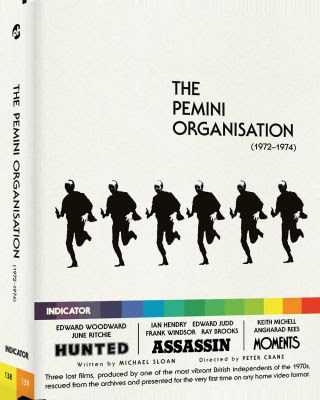
Get Hendry… Assassin (1973), Indicator Pemini Organisation Box-set

Pissholes in the snow?

Sometimes the story behind the making of a film is as fascinating as the final product itself. I’d never heard of this film but that’s not unusual as I was in junior school at the time however there’s good reason why it’s not come to my attention since then as one of a piece with other tough-edged fare of this period including obviously Get Carter but also Sitting Target, Villain, Unforgiven, Man of Violence and many more.

The film was the second one made by the Pemini Organisation made up of  Peter Crane, Michael Sloan and Nigel Hodgson who leaving film school combined forces, and the first two letters of their names, to create this bold new imprint with which to make films that would capture the new wave of British style… a “young, independent British production company…” with “enthusiasm and vitality who don’t just talk about films, they make them”.

Sadly, despite making three well-cast and inventive films in three years, Pemini ran out of steam and funding leaving their output long unseen until the release of this superb Blu-ray set including Hunted, a high-suspense thriller starring Edward Woodward and June Ritchie, and two feature films: Moments, an enigmatic romantic mystery starring Keith Michell and Angharad Rees, and this one, Assassin, starring Ian Hendry, Edward Judd, Frank Windsor, Ray Brooks and Mike Pratt. The company’s ultimate failure was not down to lack of class or imagination but the complexities of distribution and the arid marketplace in seventies Britain for films that did not quite fit.

Ina Hendry

Directed by Peter Crane from a script by Michael Sloane, Assassin is full of fresh energy from the get-go as a darkened room shows illicit hands photographing classified materials. The scenes shift and we’re at British intelligence with MI5 Controller (Edward Judd) calling in his men to authorise a hit on the suspect who we quickly see is Ministry of Defence official John Stacy (Frank Windsor). Control tells two of his finest, Matthew (Mike Pratt on excellent form, edgy and unpredictable) and Luke (Frank Duncan) – biblical reference duly noted – to keep an eye, as he’s calling in one of the deadliest guns for hire and, at this short notice, and so un-planned, anything could go wrong.

Meanwhile we find Stacy working late in his office with, incidentally, a very attractive and familiar young secretary (Celia Imrie in her first film role). We discover that Stacy’s about to be the best man of the man who has just got the promotion he was, once again, passed over for, public school educated and connected, Edward Craig (Ray Brooks). Stacy’s preoccupied about many things yet he joins Craig’s stage night and is happy to be his best man for the wedding. Stacy’s wife Ann (the excellent Caroline John, RSC member and an early companion for Jon Pertwee’s Doctor) understands both men full well and just wishes her’s would accept his achievements in rising from state school and the working class.

Caroline John and Frank Windsor

If Stacy thinks he has problems, things are about to get worse as his Assassin arrives in the UK and begins to prepare for his work. Ian Hendry is magnetic in this film, carrying a wearily professional air but also clearly traumatised by his lifestyle and a recent near miss involving an Eastern Block agent who very nearly outcompeted him. There’s only so long you can stay on top of this game and this mission has come at the wrong time as he is not only haunted by the near-death experience but actively seeking to get out of the game.

Killing time before his appointment with Stacy – he’s the perfect spot overlooking the car park of the wedding venue and where he can make the kill in a public space to send the appropriate message to the other side – he ends up in a pub talking to a very pretty young woman (Verna Harvey). Harvey is a former ballerina who danced with the Bolshoi at Covent Garden aged 14 and had a very busy seventies as an actor before, presumably, starting a family as well as moving into production. She’s very good here, a pure hearted woman who provides an opportunity for some humanity and tenderness to the Assassin who ultimately knows she cannot be for him.

Verna Hervey

The film is very good at presenting the dichotomy between “real life” as we happily assume it to be and the urgencies and sickness of professional, state-sponsored killings. Hendry’s character lives in another world, one where his peace of mind has forever been shattered by his murderous routines and the ever-present thought that he himself is being watched all of the time: a deadly weapon and, ultimately, a threat to every side.

There’s also a superbly executed rhythm as the story moves inexorably towards what will have to be a deadly conclusion. As Stacy and Ann play their parts at the wedding and our gunman enjoys his romantic interlude, we know things are about to explode… what we can’t be sure about is exactly for whom that bell is going to toll.

Caroline John, Franks Windsor and Ray Brooks

Dusty verdict: Assassin is an impactful, pacey film full of interesting moments and skilled performances, it certainly stands up both as a time-capsule but also as entertainment and I would highly recommend this set.

It includes:

·         New restorations of Hunted and Assassin from 4K scans of the only surviving film elements by Powerhouse Films

·         Audio commentaries on Hunted and Assassin with Pemini co-founder and director Peter Crane and film historian Sam Dunn (2022)

·         Organising Principles (2022, 32 mins): Crane remembers the origins of Pemini and his subsequent work in Hollywood.

·         An Amazing Time (2022, 7 mins): Pemini co-founder and writer Michael Sloan looks back at his three early films.

·         Good Chemistry (2022, 29 mins): Pemini co-founder Nigel Hodgson revisits an exciting chapter in his life.

·         A Group of Friends (2022, 14 mins): June Ritchie, star of Hunted, recalls her time with Pemini.

·         Scoring with Gerry (2022, 13 mins): the veteran Soho musician Graham Dee remembers his work with Gerry Shury on the compositions for In Search of Lebanon and Hunted


The three films are accompanied by a wealth of newly produced extras, including feature-length director commentaries, cast and crew interviews, and an 80-page book. It is a numbered limited edition – mine’s 1487/6000 – so I wouldn’t hang around if I were you, get your order in and take a trip back to a most excellent adventure: “an amazing time” indeed!

You can order from Powerhouse Films where it's on special offer!


Edward Judd

Mike Pratt and Frank Duncan

Verna Harvey and Ian Hendry

Is Ian reading Isaac Asimov's Foundation or The Assassin?

Interesting to see the ads for other films of the time, Pulp and Shaft


Saturday, 27 February 2016

Hot off the press… The Day the Earth Caught Fire (1961)


This is not only amongst the very best of British science fiction but also a love letter to the British press or at least Fleet Street when it was Fleet Street. These are the men and women who search out stories in the public interest and who work unsocial hours risking life and liver in pursuit of the “story”.

The focus is on the great art deco Daily Express headquarters and everyone from an actual former-editor Arthur Christiansen (1933 to 57 – a long stint!) – who plays Jeff Jefferson the Editor – to the machine minders and the craftsmen who worked the hot metal presses day and night to deliver the news in a world every bit as 24/7 as our own. The Express and others was always open breaking news and only ever a plate make up, quick print run and rapid delivery by its fleet of vans, from informing its public of every key development: from press room to doorstep in mere hours all verified and proof-read (mostly).

So, when governments let us down and we screw up the planet, who can we rely on for the truth?

Edward Judd and Leo McKern outside the art deco splendour of The Express
The splendid new BFI restoration begins at the end with reporter Peter Stenning (Edward Judd) walking with weary steps down a parched Fleet Street. The Thames is empty of water and a heavy sun beats down on a parched West End. Stenning makes his way to the press room and finds his typewriter roller has melted he calls down to find the last copy boy working and begins to narrate his last and most important feature…

Cut to the press room as it was, full of care-worn, wise-cracking journalists navigating their way through the fast-moving events of a slow news day. Bill Maguire (Leo McKern) cracks wiser than most and is covering for a pal, Stenning, who has lost his way following divorce and an over-reliance on journalists’ ruin. Pete can barely string a story together and is rapidly running out of favours missing deadlines and many a point.

The press room - stories must have IMPACT!
Bill sends him off to the Royal Meteorological Society to investigate stories of abnormal sunspot activity; he tries to pull in a favour from an old pal and ends up gate crashing a meeting with the minister. He encounters a helpful and distractedly-curvy secretary Jeannie Craig (lovely Janet Munro) whose attitude to his rapid-fire banter changes once she realises he’s the same loudmouth who abused her on the switchboard. Stenning needs to work on his charm.

Stenning's charm initially fails him...
Later Pete attends a CND rally at Trafalgar Square – the film is very much about nuclear weapons and Wolf Mankowitz had originally written it after the UK’s first H-Bomb tests in the early fifties.  A fight breaks out with pro-bomb sympathisers – a bit like the next Labour conference – and as Peter hops on a TV news van he sees an unscheduled solar eclipse.

Eclipse over Trafalgar Square
Meanwhile the temperature rises to alarming degrees and Pete takes his son Michael to Battersea Park Fair taking him on the ghost rain much to the consternation of his new nanny – Michael’s mother has re-married and the future’s looking posh for the youngster. After dropping him off he finds Jeannie sunbathing and has another go at apologising… maybe it’s the weather but she’s warming to him.

The two share an ice cream and then nature takes another unexpected turn as a deep fog spreads rapidly up the Thames causing panic… On a limited budget director Val Guest makes the absolute most of his special effects and even with the unforgiving clarity of Blu-Ray, the scenes of London smothered in unnatural fog are still impressive.

The mist rises over Battersea
Yet it is the human element of the story where Guest most excels, with superb performances from Judd, Munro and McKern – three people facing up to the worst hoping for the best.

Guest shows some provocative shots of Jeannie in her bathroom before Pete arrives to be offered a couple of pillows and the bath… Theirs feels like a very real relationship for the time: she reluctant to give way not trusting the look of post-commitment in his eyes. But he is serious and the situation is getting far worse: if you were the only girl in the World and I were the only boy…

Things hot up
Whilst the Ministry keeps schtum the Express boys dig deeper and establish that not only has the Earth been knocked off its axis by two nuclear bombs exploded at the same time by Russia and the USA… but it has been nudged towards the Sun (not the odious newspaper, then called The Daily Herald by the way…) with no sign of stopping. What at first seemed to be a disaster is rapidly looking like Armageddon.

Meanwhile the authorities begin to clamp down on disintegrating society and water rations and near martial law are introduced.

What a scorcha!
The denizens of Harry’s Bar – a journalistic haven next to St Bride’s Church - gather to watch government pronouncements and to toast their increasingly-bleak futures. In spite of it all there is excellent interplay between Pete and Bill – the latter always hoping to set his pal back on course, both of them talking with the clipped precision you’d expect.

But Pete is getting himself focused not just on Jeannie but on The Story. His creative “Muscle memory” kicks in and he does his best for his readers, his talent and the wonderful new woman in his life.

The Express team wait for news
As his ex-wife’s new partner says as they prepare to escape to the country, “it all seems a bit silly now” – Pete wears the look of a man who felt that all along. Now he cares and you hope the crisis can be survived for this realisation to provide him more than short-term benefit…

Mankind’s last throw of the dice is to repeat the two atomic explosions in the hope of reversing or at least halting the planet’s drift. The minutes count down and then we return to the film’s beginning as Pete makes his weary way back to the Express. In the print room the crews prepare two front pages one for salvation and one for doom… Church bells hint at the former but you have to make your own mind up…

Parched Fleet Street
Dusty verdict: Undoubtedly one of the best British films of the period, The Day the Earth Caught Fire still stands up as a testament to man’s enduring humanity even in the face of such a crisis. The message is a simple one – take good care of the ecology and, enjoy yourself, it’s later than you think.

Leo McKern went on to have a long and illustrious career but his other co-stars were less fortunate, Edward Judd surprisingly never established himself as a regular leading man – a difficult temperament possibly holding him back (according to Val Guest) – although he got regular work and was a fixture of voice-overs in the 70s and 80s.

Janet Munro
Janet Munro was less fortunate, dying of heart failure at just 38 – gone far too soon.

The film is available on Blu-ray and DVD from Amazon and every home should have one!