Showing posts with label Laurence Harvey. Show all posts

Saturday, 26 May 2018

Can’t Buy You Love… The Magic Christian (1969)


Released just at the last gasp of the Sixties, this adaptation of Terry Southern’s 1959 novel fares a little better than the earlier adaptation of Candy (written in 1958 and filmed in 1968). If Candy was broadly about sex (and respect) then The Magic Christian is all about money and the idea that every man has his price.

Produced by Denis O’Dell (who gets name-checked as Denis O’Bell in eccentric Beatles B-side “You Know My Name (Look Up the Number)”) and directed by Joseph McGrath, the film stars Ringo Starr and features Come and Get It as a theme tune written by old mucker Paul McCartney, performed by protégés Badfinger. As that tune plays over the opening credits you feel that perhaps the film will be better than you remember but, in truth, whilst it is, a little, overall, it’s not quite the sum of it’s talented parts. As with Candy and others of the period, it’s almost as if making the political/philosophical point, is all that really matters and so it is repeated without ever being progressed with no solution offered.

Ringo and Peter
What’s the thing that money can’t buy, Beatles fans…? The answer was given in 1964. But with this film, in 1969, it was Money (That’s What I Want) this time without the irony.

But I’m being too hard because this film has dozens of period faces, a couple of Pythons, Harry Carpenter commentating. Laurence Harvey stripping along to Hamlet’s most famous soliloquy, Yul Brynner as a surprisingly convincing cross-dressed cabaret singer, Christopher Lee, Richard Attenborough and Raquel Welch in leather bikini and a whip. The narrative may lack purpose, but you can’t say it’s without incident!

Peter Sellers, getting down with the kids, plays Sir Guy Grand KG, KC, CBE a man with money and sense who decides to adopt a down and out, Youngman (Ringo Starr) after finding him sleeping rough. To the consternation of his advisors, he had Youngman declared as his son and inheritor and proceeds to show him how the World works. Youngman keeps on calling him “Dad” and it’s all very arch.

Isabel Jeans, Peter Sellars and Caroline Blakiston
Youngman joins his new Dad at the theatre along with other members of his new family, Dame Agnes Grand (played by Isabel Jeans who had begun acting in the silent era) and the Hon. Esther Grand (Caroline Blakiston). They’re astonished watching Laurence Harvey as mid-soliloquy he starts to strip… the first of many jokes enabled by Grand’s wallet. Fair to play to Lauro though it is funny!

Next a grocer’s shop full of classic sixties brand names all of which are sold off at ridiculous prices… “Ha-ha Mr Wilson, Ha-ha, Mr Heath…” Then we’re in a boardroom on a train where Guy introduces his new son and a new concept car, The Zeus which is a gigantic wealth-expressing car that will crush all others. The promotional film is very like a Terry Gilliam spoof mixed with Yellow Submarine.


The pace is relentless as others on the train – Hattie Jacques and a businessman – are pranked and a hot dog vendor (Victor Maddern) is left holding far too much change as the train pulls away – one of Grand’s favourite tricks in the book. At least the vendor was trying to give the billionaire his money back!

Onto a hunting party using tanks and big guns rather than shotguns and why not? There’s a parade of soldiers and a banner declaring it’s Grand to be Grand as the inedible hunted by the distasteful is presented by the finest chefs.

Back to Westminster and meeting the servants at Grand’s pied a Terre then, as the family reads and plays the cello, there’s actual news footage showing marches and distress across the world none of it impinging on the Grand living room; or does it?

John Le Mesurier , Ringo Starr and Peter Sellars at the Boat Race
They watch as a wrestling bout turns into a love match – all courtesy of Grand’s grands – and then go out for expensive Kellogg’s’ Corn Flakes as Guy makes like Mr Creosote in Monty Python’s later Meaning of Life (or indeed, the earlier mountain of beans feast in Magical Mystery Tour) and has an entire restaurant humiliate itself.

The film climaxes with the sailing of the Magic Christian cruise ship which features a wealthy clientele terrorised by Christopher Lee as the ship’s vampire, Raquel Welch in sadistic charge of the engine room – dozens of naked women rowing – homo-erotic cabaret disturbing some of the straight-laced audience (chiefly Terrance Alexander), Yul chatting up Roman Polanski in his blonde wig and Wilfred Hyde White as the sloshed skipper. All descends into anarchy… before the secret is revealed.

Raquel Welch
Then, a last coda with hundreds of city workers diving into a vat of steaming sewage on the Southbank in order to fish out the money thrown in by Sir Guy… Thunderclap Newman’s "Something in the Air" plays as his point is proven despite the smell. It feels like a pop video and it feels heavy-handed but nowadays we have found new depths to plumb and maybe we take it too much for granted.

The film falters partly because of this dissonance but also because it is perpetually cynical, as Candy was, although the central character there was innocent. Here it feels more like Sir Guy and Youngman are just being cruel and we could have done with at least one person to stand up and say no thanks or one scenario that doesn’t rely on the assumption that all of us are in it for the money.


Dusty verdict: Worth watching for the style and the music as well as spotting a host of character actors and the pre-Pythons. Don’t expect to be uplifted or even converted… now, more than ever, we’re greedy bastards.

There are some genuinely funny parts – strip Hamlet and Spike’s parking ticket munching – and it does work when there are targets in genuine need of being taken down. Another imperfect psychedelic production; perhaps too over-ground to hang onto it’s arguments… undermined by the money men, man.

Peter Sellars and Spike Milligan
The Magic Christian is available on DVD and even Blu-ray – perfect for the Raquel fans who want to see the all-female slave scene in clearer detail. Slavery as sexual exploitation is surely not cool.


Monday, 25 November 2013

Cat on a cold tin roof... Walk on the Wild Side (1962)

 
“Lurid, tawdry, and sleazy ….”

Well, that sounds promising! The New York Times was clear in its appraisal of this 1962 adaptation of Nelson Algren’s novel but it doesn’t managed sustained instances of any of these descriptors.

It does have a stunning title sequence as a black cat prowls along accompanied by Elmer Bernstein and David Mack’s famous song (no relation to Lou’s Wild Side…) and, foretastes the film as it gets into a brief fight with a white cat... before carrying on its way with serene feline indifference…

On the road...
Things start off pretty energetically as to young loners meet and fall in to alliance on the road. One is a quietly determined man of the Yellow Rose, Dove Linkhorn (Laurence Harvey)… who has few words but appears of string character and conviction… and they say what’s in a name?

Laurence Harvey
The other is a young girl with life on her mind and troubled in her veins… Kitty Twist (Jane Fonda) and I say again: what’s in a name?

The two sleep rough in road-side concrete pipes and hitch lifts on their way to New Orleans, Dove’s looking for his religion, a lost love, whilst Kitty’s looking for a good time and what-ever she can get. This includes Dove who repulses her advances – there’s only room in his heart for one girl.

Jane Fonda
Their alliance is sundered as Kitty’s petty criminality is exposed at a café run by a Mexican lady, Teresina (Anne Baxter) who helps the couple only to have the young girl steal her pearls. Dove returns them in disgust and wants nothing more to do with Kitty…


Teresina offers him work and he tells her off his quest to find his love, a sculptor named Hallie Gerard (Capucine) years after his loyalty to a dying father had split them apart as she headed for artistic fulfillment in arty Louisiana…

Dove works hard whilst Teresina helps him look for Hallie through ads in the local paper: she has a heart of gold and an eye for this new man but she respects his own desires. Nothing is forthcoming but, just as things seem helpless; someone provides a tip off…


Hallie is living with a strange bunch who just happen to run a cat house called the Doll House (see what they did there?), initially it appears as if she’s continuing with her sculpting career but she’s only doing a favour for the dominatrix who runs the House, Jo Courtney (Barbara Stanwyck who is the best actor on show by a street).

As the masculine abbreviation of her name suggests, Jo wears the trousers and dominates the men, from her crippled husband, mysteriously relegated to using a low-set cart instead of a wheelchair, to the muscle who maintain order in this curious, heartless culture.


And, unsurprising to modern audience but possibly shocking at the time, Jo seems to have an emotional attachment to Hallie, one that Dove will find very hard to break.

In truth, the film loses momentum at this point. Harvey does well with his accent but he wears it like a concrete coat and doesn’t emote very well as if he’s stuck on the “surly” setting. But the main problem is Capucine who’s beauty masks her acting ability. She also looks out of place in a bordello and one really can’t quite understand how she came to get stuck.

Barbara Stanwyck
Her reunion with Dove gets more convincing as they head off on their own and Dove confronts a preacher who takes issue with this fallen woman… he doesn’t know yet. He finds them a place and Hallie begins to dream of escape (although why they don’t just nip down to the train station and get a single somewhere far away is beyond me…)

But the more obvious Hallie’s temptation to leave the more the iron fist of Jo starts to descend to block off her options.


Dove encounters Kitty at the Doll House; she has been rescued from imprisonment for vagrancy and owes Jo a lot. The elder woman sees a way to use her to blackmail Dove into leaving her girl alone. By accompanying Kitty across the state line, Dove has potentially committed a felony as she was underage…

Doll House shakedown...
But Dove won’t cave into these threats and has only one thing on his mind. Hallie dithers and Jo ramps up the physical threat… can Kitty actually do some good for once in her life?

Everything comes together in a violent and confused ending which is very neatly tail-ended by the closing credits which feature our black cat strolling over a revealing piece of crumpled newspaper…

The final confrontation...
Directed efficiently by Edward Dmytryk, Walk on the Wild Side has plenty of the former but not so much of the latter. The town is more strange than wild and the character’s motivations and actions are sometimes a bit forced to fit the situation rather than explain it.

Defiance...
The story is set in the early thirties and yet it has more of the feel of a fifties noire, especially with Mr Bernstein’s excellently expressive score.

Overall Jane Fonda does well and, it has to be said, looks great, whilst Capucine looked good but acts awkwardly and inconsistently making the best of her casting but even so… Laurence Harvey does well with that accent and is believably intense – a very talented actor here not so well served by the script.

Capucine and Barbara Stanwyck
But Stanwyck takes the honours, pure class and experience.

Dusty verdict: Worth it for the opening sequences from the cat to wild Kitty! It falls off after that but the ending is never predictable. It’s available on DVD but I think I’ll stick with the VHS…

Sunday, 3 November 2013

Soho sweet and sour… Expresso Bongo (1959)


A dip into the late fifties by way of comparison with Beat Girl… this film features a teenage Cliff Richard but still manages to carry enough Frith Street grit and Denmark Street guile to evoke the spirit of Soho. Setting all else aside, the film's use of genuine locations literally grounds its potential cheese in the shops, clubs and coffee bars that give Soho its timeless air: facia may come and go but the grind goes on forever... timeless good times.

Lisa Peake and Laurence Harvey
Based on the successful stage play of the same name and initially intended to feature one Tommy Steel taking side-swipes at the industry that birthed and abused him, it eventually featured the hotter, younger Harry Webb from Cheshunt, near Enfield. Just as Harry got a name change to Cliff so does his would be drummer, Bert Rudge, get re-branded as Bongo Herbert in this film: anyone doubting Expresso Bongo’s intent should check the surname…

Cliff Richard
There’s a wonderful cameo from Susan Hampshire playing a golly-gosh deb besotted with Bongo: “go on, say something in Cockney, apples and pears or something…” she pleads, sounding almost like Armstrong and Miller’s cut-glass chavy pilots…  This is the British laughing at themselves and joking about how easily they’re fooled, yet there’s also a harsher edge that ultimately leaves the successful on the slide and those on their uppers on the up.

Johnny extends credit to Kakky
Laurence Harvey uses his considerable skills to create a thoroughly dislike-able agent and serial abusers of goodwill: Johnny Jackson. We see him working his way down a Soho Street palming his best wishes to all whilst delaying his debts and wisecracking his way to nowhere… networking is only a payday away form not-working. He has a soft-spot for old man Kakky (Martin Miller) a former director... is he a vision of Johnny's future?

Sylvia on stage
His long-suffering girlfriend Maise, the sublime Sylvia Syms,  can sing and dance a bit (not enough for Johnny) and we see her do a rather risqué number at a “gentlemen’s club” surrounded by barely dressed chorus girls and the famed frozen semi-naked tableaux that allowed the strip clubs to avoid censure… It was a particularly British form of censure: allowing a view of naked flesh that was only permitted if it was motionless as if that somehow made it less real, less… overt. Only a public-school educated judiciary could work out the logic in that one.

It's "educational" so long as they don't move...
Never-the-less, this scene is still fairly frank for the time with scant coverings for the artistes and Miss Syms in the most revealing of costumes… Maybe the film’s musical status enabled them to treat this all in a jokier context than say the uncut version of Beat Girl?


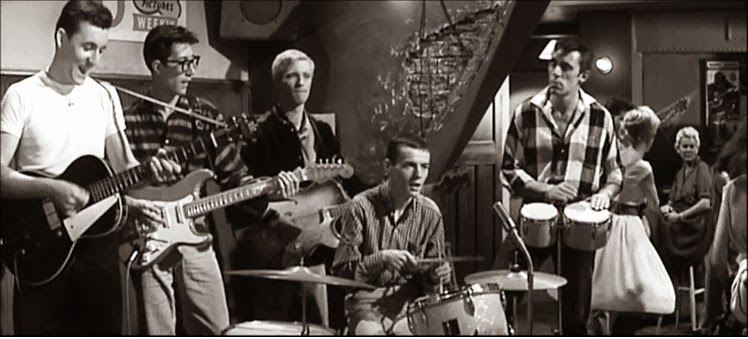
Anyway, soon enough the action moves to a suspiciously-spacious coffee bar basement where cheap-skate Johnny is taking Maise for some fish and chips. Their evening is cut short though when Johnny hears Bert sing as he "plays" his bongos backed by Hank Marvin, Bruce Welch, Jet Harris and Tony Meehan aka The Shadows (I’ve tried hard but can’t quite get the sound to sync with Cliff’s movements… by “hard”, I mean once…). In spite of Bert’s protestations that he wants to be a drummer (can’t he see The Shadows have already got a decent percussionist?) Johnny insists he can be a pop singer and that's the last we hear of Cliff's bongos...

Bruce, Hank, Jet and Tony... actor Barry Lowe on bongos
Cliff is ridiculously young but what catches the ear is how much reverb young Hank is using on his guitar, they sound a bit more rock n roll than they’re given credit for!

The newly christened Bongo meets Johnny at his parent’s flat and, in spite of motherly indifference and fatherly drunken stupor, a deal is struck and Bongo signs a contract splitting everything 50:50…

Hermione Baddeley, Lawrence Harvey and Cliff
Johnny kicks into gear and begins to hype his new property; jumping a ride on anything he can to increase his profile. He hi-jacks a BBC documentary being made by the actual Gilbert Harding, on Soho youth, to show off Bongo’s singing and then works his way onto the broadcaster's show to shout down the analysis of a pompous psychiatrist (Patrick Cargill) and a wet priest (Reginald Beckwith).

Denmark Street, London's actual "Tin Pan Alley"
Johnny suckers in the boss of Warwick Records, Mr Mayer (Meier Tzelniker), getting Maise to make a call there, pretending to be from HMV and Bongo’s debut single is soon shooting up the charts.

But Johnny’s biggest twist comes in forcing Bongo on the stage alongside Dixie (Yolande Donlan – director  Val Guest’s wife) for her triumphant UK comeback gig at the Dominion Theatre in Tottenham Court Road. He’s a smash and it’s not only Johnny that sees a way of hitching a ride on his rising star.

Cliff, speedos and Yolande Donlan
Dixie’s soon being more than motherly with Bongo luring him to her penthouse apartment atop the Dorchester Hotel – cue the shots of Cliff in speedos that were such an influence on a young and impressionable David Hockney.

But Dixie cares about the kid and especially his rotten contract and it’s dog eat jackal over the closing sequences as everyone fights over the spoils. In the end, you’ve pretty much given up hope for anyone in this sordid world but defeat brings out the best in some and a chance emerges for the film’s most likable and long suffering character…

The battle for Bongo
This uneven film interests and irritates in equal measure but has some good characters and dialogue – “I recognise the face but not the flattery” says Dixie to the ingratiating Johnny.  Harvey is good as the over-bearing huckster and has more than a passing resemblance to Jude Law; he went on to major film stardom and had an edge.

Sublime Sylvia
Sylvia Syms also excels in one of her patiently trusting roles: she’s said it herself but she didn’t always have good or lucky marriages in her films of this period. 

Mr Harvey on screen
Cliff is still learning the ropes but passes muster playing someone not unlike himself. More anodyne fare was to follow and here his role is earthed rather more than in Summer Holiday. Odd that his character appears to be pretty much a virgin, there’s no real love interest other than the motherly-predatory Dixie and religion is introduced as a way of selling a better image (a move I would guess he was later very embarrassed by).

"Go on, say something Cockney..."
There are also glimpse and you’ll miss them cameos from Burt Kwok and the aforementioned Susan Hampshire who would play alongside Cliff in Wonderful Life.

But this doesn’t feel like a “Cliff film” but a twisted ode to the dysfunctional pop business filmed in the streets at its very heart. In the end my star of this film would be London and in particular the surrounds of Soho as old as William Blake and alive still with the spirit of mischief.

Martin Miller, Sylvia Syms and Laurence Harvey
Dusty verdict: Worth watching just to street spot but Harvey and Sims make a good couple and you also have the young Shadows rocking in a way that convinced even Neil Young that they were cool! Beat Girl has the edge though if only for John Barry’s incendiary soundtrack, but the Soho scenes work better than the showbiz second half.

You can buy the DVD on Amazon but it's a bit of a collector's item thanks to the enduring appeal of Mr Harry Webb.
That is Wolf Mankowitz carrying the placard down Hanway Street...
Old man Kakky admires the artistes
Gilbert Harding plays himself