Sunday, 30 June 2024

Queasy Riders... The Wild Angels (1966)


We wanna be free to do what we wanna do. We wanna be free to ride! We wanna be free to ride our machines without being hassled by The Man. And we wanna get loaded.

Oh man, I’m not really sure where these guys are coming from? This was the late Roger Corman’s inspiration for the biker films of the 60’s counter culture, The Wild One(s) for the Age of Aquarius, outlaw bikers for the hippies and the genesis of Easy Rider and Peter Fonda’s enduring association with Harley-Davidsons that I saw spoofed in The Cannonball Run by the man himself.

Corman always had an eye for trends and the kind of entertainment that would reach emerging audiences even if his budgets we rarely large enough for him to take full advantage. Here in a story written by Charles B. Griffith and an uncredited Peter Bogdanovich – how many careers did the great man encourage? – we see the seeds of Altamont and the demise of the counter-cultural dream as the consequences of the bikers’ rebellion leave them with nowhere to go but down as Fonda’s oft-sampled quote above reveals.

The film ended up being one of the most successful low-budget indie films in history and yet it seems pretty hollow and, if anything, disapproving of a culture that is based on such halting and insubstantial dogma as being “free” and getting “loaded” especially when the ensuing party occurs at a funeral of one of their gang members and with sexual harassment/abuse on the agenda as well as extreme disrespect for their dead pal and his funeral rite, so nihilistic as to only really play teasingly with the subject matter of alienation.

These guys wear swastikas as a deliberate provocation to the straight world and yet that’s all it is a wind up signifying pretty much nothing in terms of an alternative vision. A decade later the Sex Pistols, Siouxsie Sioux and Joy Division would appropriate Nazi imagery and, as we now know, not all of them really meant it, “maaaan”! You say you want a revolution well you know… we all want to change the World…

No one could expect Mr Corman to really mean anything to be fair and the mere act of rebellion seems to be enough here as elsewhere for people who felt out of step with American society as capitalism followed its own nihilistic exploitation of some and exclusion of others.

Corman took his research seriously though and not only interacted with Californian Angels he also featured members of the Hells Angels from Venice, California and the Coffin Cheaters motorcycle club… irony overloaded in their nomenclature there. There is indeed some fine bike riding in the film which moves at a pace and as with its abovementioned forbear, rebels against whatever it is you’ve got invested in society as it was and is.

There are two visceral stand-out performances from the husband and wife team of Bruce Dern as "the Loser" and Diane Ladd as his on-screen wife, Gaysh. Both give their all to add an extra edge and smuggle more meaning than even Corman may have intended as the real victims of this rebellion but also, of course, The Man and his evil ways. They’re both so full of force the blow the rest off screen and, during their downtime, even managed to conceive daughter Laura Dern which perhaps explains, as Sailor said, how the way her mind works is God’s own mystery…

Fonda, of course is no slouch as gang leader "Heavenly Blues" (or "Blues"), whilst Nancy Sinatra is also excellent as his girlfriend "Mike". Dad Frank was apparently so concerned about her cavorting with the Angels that Corman had to reassure him that Nancy would be protected although as it turned out she was more concerned about Fonda’s offer of LSD than the gentlemen on bikes.

The film follows the gang falling foul of the cops after riding in search of Loser’s bike which has been stolen by a Mexican biker gang from Mecca, California. The Angels find and battle their rivals but the police arrive forcing them to take flight leaving Loser behind, he steals a police bike but gets shot in the back and hospitalized. Fearing for their friend’s incarceration the Angels break him out and take him to a bar run by one Momma Monahan (Joan Shawlee) but there’s no doctor for the injured man and he passes away.

The Angels want to see their friend off in their own way and fake a death certificate before arranging a funeral which degenerates into a drunken orgy of violence and sexual assault – they get loaded but rape for Loser’s girl Gaysh is hardly the freedom Blues bangs on about… There’s more to come but ultimately this whole biker “scene” is based on emptiness and anger which, in the context, shows the filmmaker’s view far more than the bikers’? The Man is the ultimate cause of Loser’s demise and yet the Angels taking the law into their own hands started off the mayhem. Also, Nazi regalia and Hitler’s flag on the coffin… it’s so enduringly offensive it’s hard to contextualise.

Dusty Verdict: The Wild Angels captured a moment even in what presents as a judgemental way, although Corman was happy to show the “loaded” generation in full swing. There are those excellent, humane performances from the Derns as well as Fonda’s intensity and Sinatra’s winsome charisma, to leave you engaged and enriched amongst the motorcycle roar. The real Angels also add the edge and the connection with this genuine counter culture.

There’s also some good support from an under-used Michael J. Pollard and Gayle Hunnicutt who was surely far too demure to be a biker chick?

In the end, Fonda was far from finished with his Harley and he would go on to continue his counter-cultural search with Easy Rider and other films. Perhaps, in terms of the meaning of this film that’s the biggest take-away, the enemy was clear but the philosophy and the constructive response was inspired by Corman’s work and the search for a solution to state controls and possible freedoms continues to this day.

Rest in peace Mr Corman and Mr Fonda.


All we want from you are the kicks you've given us
Under neon loneliness
Motorcycle emptiness

James Dean Bradfield / Sean Anthony Moore / Nicholas Allen Jones (1992)


Friday, 31 May 2024

Victor Spinetti's tears... This, That and the Other (1969)

Victor and Vanessa

So, another British sex comedy and a film directed by Derek Ford who went onto a string of productions in this lucrative sub-genre; Groupie Girl (1970), The Wife Swappers (1970), Suburban Wives (1971), Commuter Husbands (1972), Keep It Up, Jack (1974) and Sex Express (1975) and more. The mind boggles at the idea of 70’s British Rail allowing an express service of any description let alone one involving these additional benefits.

 So far, so salacious, but exactly how sexy is This, That and the Other – aka A Promise of Bed in the USA – and how funny is it? Well, it’s a mixed bag… and, as usual, the laughs are often at the film’s expense. There are three stories of varying tone and only loosely linked by theme and events but, overall, it’s a fun ride if taken in context.

Dennis is menaced
 First up we find Vanda Hudson as Susan Stress who is so desperate for a role in producer Gordon Sterne’s film that she decides to seduce his innocent photographer son, played by Dennis Waterman no less. Whilst it’s hard to think of our Dennis as in anyway this innocent after all the moments we’ve shared over the years, he does his best as he nervously tries to photograph Vanda who goes to ever more outlandish lengths to shock him in a succession of increasingly provocative costumes. Full marks to Vanda here as she has to improvise madly for most of this story before ending up in the bath and then in bed with the future TV detective and Minder…

All her efforts are not wasted on the young man but there’s a delicious twist in the tale that wouldn’t work quite as well without her commitment to the role.

The second story has the most substance and an especially impressive performance from the highly versatile Victor Spinetti as George, a young man preparing for suicide until he’s interrupted by a lovely young woman called Barbara played well by Vanessa Howard who thinks his is the location of a party. Spinetti does so well to play George’s depression in ways that win our sympathy but not distress; suicide’s no laughing matter, especially in this context, and what we’re left with is a poignant tale that rises above the sauce and still makes us hope for the best outcome.

Victor hangs on

Barbara rationalises his masking tape, continental quilt and open gas fire as the theme for a party which is to be based on suicidal people and when the other guests arrive they take on the personas of various forms of suicide with Valery Leon deciding to dive in the bath – director Derek Ford not wasting his assets here. We also get the sublime Alexandra Bastedo as bored socialite Angie whose arranging her next event almost as soon as she arrives along with Michel Durant as a so-drenched-in-ennui-you-don’t-know-he’s-completely-pissed aristocrat.

All of these characters send flickers across George’s eyes merely highlighting his isolate desolation but perhaps there’s hope for him after the party’s over if only Barbara has truly noticed him…

The film can’t possibly linger on such thoughts as we enter the mostly surreal final segment in which a sex-starved taxi driver, the excellent John Bird, leaves a cinema after watching an X-rated film just like this one, only to be caught up in a psychedelic party that blows our minds. His post film reverie, and boiled egg dinner break, are interrupted by a call to take a glamorous blonde, the sublime Yutte Stensgaard, from a London night club to an ultra-mod house in the countryside. She falls asleep drunk in the back of his cab but he can’t stop looking at her and fantasising… I like the way this section pokes fun at its own audience!

Hallucinations of a Taxi Driver...

The dopey driver is hit by a sports car driven by the posh drunk from the previous episode and the former falls into a dream, as his blonde makes her way to the country house and he follows to witness the most outrageous of events. Women frolic naked in an indoor pool and appear and disappear as the swooning psych sounds of Christos Demetriou and John Kongos score illuminate events. Cleo Goldstein dances as a girl wearing only polythene hands, and our taxi driver has clearly travelled way too far south of the river…

It's a Stanley Long production with a budget of some £8,500 so well played all round for coming up with something that is more substantial than many a Brit sex-com. As The Monthly Film Bulletin wrote, it may have been "… short on comedy but rather better performed than these things usually are.” Although I don’t quite agree that “… the one barely memorable moment is provided by Miss Hudson being pursued round an apartment to the strains of the Light Cavalry Overture."

It's available on Amazon Prime and an increasingly collectable DVD!

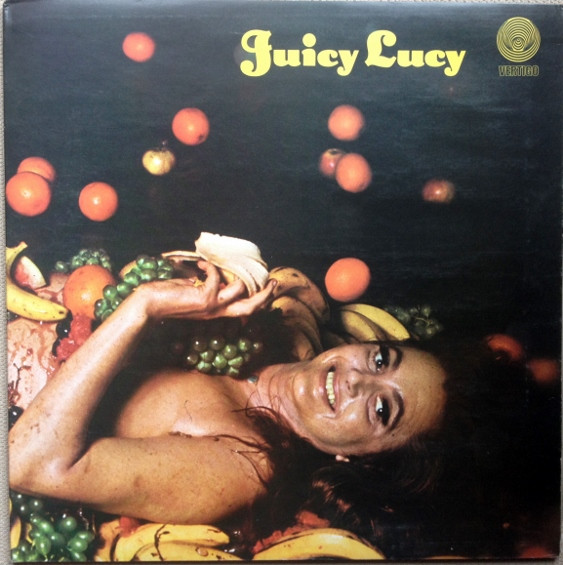
Yutte is covered in fruit... much like the cover of the prog blues LP, Juicy Lucy (Vertigo, 1969)

 
Primary


Monday, 29 April 2024

Motorcycle Emptiness? The Girl on a Motorcycle (1968)


This is a film from my youth… it was family viewing in the living room but I’m not sure we made it all the way through which intrigued me enough to watch it on my small black and white portable when it was screened by HTV in the early eighties… Of course, then I had no idea that the director and master of so many psychedelic visual effects, was none other than Jack Cardiff, previously a cameraman for Powell and Pressburger and so adept at enabling their magical realism.

With its theme of sexual infidelity, head versus heart and the visceral sexiness of motorcycling in nothing but a catsuit and boots, The Girl on a Motorcycle has often been reviewed as a guilty pleasure and there’s no end of references to sadomasochism, tapping into both the sexual freedoms of the time as well as the darker neo-Giallo elements and, of course, Bunel’s Belle du Jour and the works of Jess Franco and beyond.

The results are mixed but it’s a wild ride man that features direct-to-Sun camera shots that capture the same optical affects as the following year’s Easy Rider. The latter film may have been more directly linked to the youth movements of the time but there’s still something stirringly free and risky about a blonde on a motor bike whether he’s called Peter or Marianne, albeit mostly played by British Grand Prix motorcycle champion Bill Ivy, blonde wig not quite convincing as he speeds around the country roads on a Harley Davidson Electra.

Marianne Faithful and the Harley

Based on the 1963 novel La Motocyclette by André Pieyre de Mandiargues the film was released as Naked Under Leather and was the first film to receive an X rating in the United States, clearly on purpose. “Racy” was on the mission statement and using, pop singer and girlfriend of at least one Rolling Stone as the lead character, Rebecca was obviously considered a masterstroke. Faithful had already appeared in I’ll Never Forget Whatsisname (1967) with Oliver Reed and would go on to feature in Tony Richardson’s Hamlet (1969) with the great Nicol Williamson, Anthony Hopkins and Judy Parfitt.

So, she could act without doubt but she was also from the intelligentsia and, as coincidence would have it, related to the Leopold von Sach-Masoch, her great-great uncle, who wrote Venus in Furs and, of course, coined the term, Masochism. Marianne was later found wearing only a fur rug by the police when they raided Keith Richard’s house looking for drugs. All a far cry from the catholic convent schoolgirl who also lived in Ormskirk for a while growing up as her father completed his doctorate at Liverpool University; you could have stuck around and met George or Ringo?

Anyway, here she’s a posh young thing trying to escape the expectations of her father Marius Goring, an academic bookseller who would much rather she stayed and helped with the family business than run off and marry young musician Raymond (Roger Mutton, here dressed as lamb…) but there is far worse to come sir.

Alain Delon and Marianne

From the film’s opening Rebecca is dreaming of Daniel (Alain Delon) a sexy but distanced academic who she met as he browsed her father’s shelves looking for a volume to meet his needs. Daniel is dreamy but also devilish, looking at the young woman’s derriere when he really should be paying attention. He is interested in sexuality and not so much romance whereas Raymond has more mundane things on his mind and is about as sensual as a semi-quaver. Rebecca thinks of her first encounter with Daniel and the cruel excitement he offers has her dreaming of him as a circus ring master driving his motorbike around Raymond as he attempts to entertain the crowd with his feeble cello.

Cue, sequence of Rebecca on a black horse, leaving the circus tent and heading into the psychedelic outdoors, total sexual and bodily freedom and an inspiration that, as soon as she wakes up she resolves to visit her lover in Germany, hours away from the stultifying marital home in boring Belgium. The film features long monologues from Rebecca as she contemplates her seismic reunion with Danielle, pulling on only her fur-lines leather jacket and leather boots as she takes out her bike and roars off to the border through the suburbs that, even after a few months of marriage, already wear her down.

She has travelled this way many times before, never able to resist the lure of Daniel for long and encounters leering pump attendants, touchy-feely customs officers and one less lecherous, who she assumes is “queer” … naturally. But, comments of their time apart, Rebecca is celebrating her sexuality and is planning her reunion down to the last detail; she must arrive around 8am when he will be in his garden room and surprised as he will be to see her, they will renew their physical bond with an intensity far beyond what she has experienced with her ill-chosen husband.

On and on she rides and back she goes in a reverie to their romantic history and those intense moments and before the audience can be too disapproving of her leather-clad sensuality, there are those constant reminders of how men, generally, view women who are sexually present… a squad of soldiers cheering when they find her resting on a bench, not wanting to be too early for Daniel. The closer she gets the more we learn of his instructing her on his fine British bike, a Norton, having liberated her, despite his own romantic detachment, his still broken heart, he makes her into a motorcyclist and then sends her the Harley as a wedding gift… knowing full well that she will only use it to return to him.

Dusty verdict: Girl on a Motorcycle looks, mostly, gorgeous but there are a few too many odd shots of Faithful cavorting on a bike raised up on the back of a truck; the technology wasn’t quite there to show her riding in ecstasy actually on the road. There’s also a predictability about the direction of travel and the feeling that she will pay for all this freedom and sexuality even as the audience, mostly and not including that German border guard, enjoy Marianne’s beauty.

The film’s other issue is that despite Marianne and despite Alain, it isn’t that sexy especially with dialogue like 'Your body is like a violin in a velvet case…”, oh… “skin me!” There’s an awkwardness between the two leads in places and their flame burns brightest when Daniel is teaching her how to drive not unzipping her catsuit like a banana.

Cardiff’s psychedelic sequences and his gift for capturing landscape make it a visual feast yet maybe there was too much convent school left in Marianne. At least in this context… Mick would have a completely different take…

Alain abides...