Sunday, 26 February 2023

Get Ollie… Sitting Target (1972)


There was clearly something in the air in the early seventies for British Films, and it wasn’t just budget film makers cashing in, but some of the biggest producers with mainstream stars, Michael Caine’s iconic gangster in Get Carter (1971), Nicol Williamson returning to Liverpool in The Reckoning (1970), and even Richard Burton in Villain (1971). There was clearly a public fascination with the men of violence, to almost quote Peter Walker’s Man of Violence (1969), and the arrest of the Krays together with changes in film censorship meant that sex and hoods and rock n’ roll were splattering screens a lot.

It was only a matter of time before Oliver Reed got caught up in things and he’d had some form as had Ian McShane who was with Burton in Villain, but Ollie was playing nihilistic hard men even as far back as his threatening turn as leader of a wayward, Weymouth biker gang in The Damned (1962). In truth there was always something about Ollie, a feeling of barely suppressed ferocity, menace and a capacity for violence. Now that’s all acting my dears but you wouldn’t really be that surprised if Mr Reed could handle himself.

He starts this film in impressive form, working out in his cramped cell and looking very much like a caged animal. His character Harry Lomart is doing time for armed robbery which resulted in him killing a guard, who, according to Harry, should have just stayed out of the way. He’s a career criminal used to the risks and the rewards of his profession as is his neighbour Birdy Williams (McShane) who was on the ill-fated job with him.


Jill St John and Oliver Reed

Today Harry gets a visit from his wife, Pat (Jill St. John who appears to be dubbed by an unknown English actor, which is a shame), who hasn’t seen him since the trial. Harry loves Pat and she is the thing that keeps him going through the long stretches. Something has however changed, and she is tired of waiting, especially now he’s in for a long stretch and wants out, especially as she’s seeing another fella and is pregnant… Harry smashes the reinforced glass between them and tries to throttle her and it takes three guards to pull him away.

He's sent to solitary for weeks bashing himself the walls and swearing revenge… by the time he gets back to his cell he’s ready to break out and so is Birdy. They hatch a plan with wheeler-dealer MacNeil (Freddie Jones, who is always such good value) and, with the aid of a bent screw played by Mike Pratt, they make a daring escape, just about managing to scale the walls in time to drop to their freedom a passing lorry set up by MacNeil.

Ian and Oliver on the run

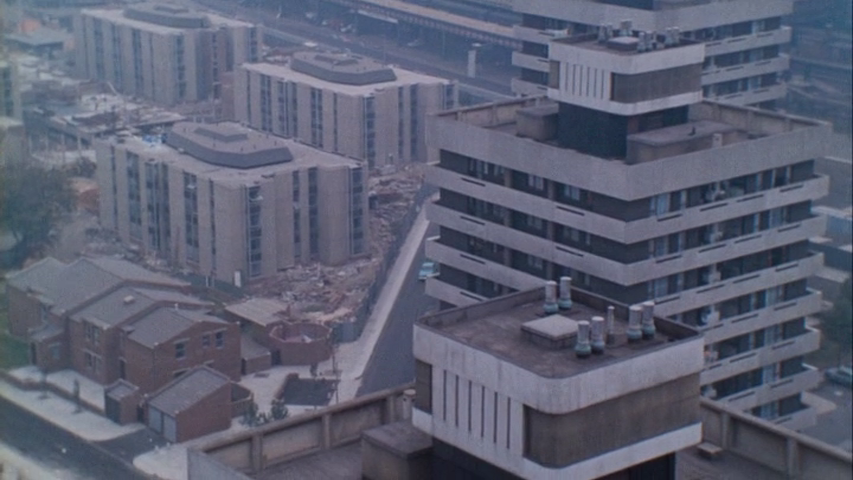
Birdy wants them to lay low but Harry’s a man in a hurry and after obtaining a gun sets about stalking his wife even though the police, led by Inspector Milton (Edward Woodward), are keeping on her home at the top of a tower block in the Winstanley and York Road Estates, Battersea. Despite all their efforts, Harry catches Pat unawares and, despite the intervention of Milton, who he almost throws over the balcony, he has to flee as the sirens start and, in a surreal sequence, he evades two motorcycle cops dodging among the sheets and the washing.

From this point on it’s a two-way game of cat and mouse with the police after Harry and Harry after Pat, with Birdy’s help, Harry plans to get hold of their hidden ill-gotten gains and to use this to secure his escape but things begin to get complicated with former allies quickly turning into foes as everybody tries to “deal” with Harry…

Dusty verdict: Directed with purpose and intensity by Douglas Hickcox Sitting Target is a very effective thriller which matches some of those hyper-violent crime capers for moral force and a script with more than one twist in its tail. For thos eof you who love period locations it's also a treat and feels very much a part of the London I almost knew... talking of which, Hickcox directed Les bicyclettes de Belsize (1967) which mapped out Hampstead and north west London just as well: he knows how to film location.

Jill St John and Edward Woodward

Of course, you can’t argue with the leading cast members and we even get legend, June Brown as the Lomart's Neighbour. In the end it’s Oliver Reed who carries the film’s most violent and tender moments, it’s quite something to see.

There’s also an excellent score from Stanley Myers which features synths and hard-edged jazz which perfectly captures the fast-moving action and the fierce emotions in a film which for all it’s violence, is as much about relationships and love as anything else. Myers’ score was released by Finders Keepers Records in 2007 and is, of course, now very collectable!


Sunday, 29 January 2023

Hippy-hippy shakes... The Happening (1967)


Well... this one starts of like so many sixties teensploitation films with a really annoying group of students/youngsters with questions, boring ennui and rebelliousness without much due cause, but ends up redeemed by an outstanding performance from Anthony Quinn who stares down the  barrel of an empty life and taking it all on the chin is ready for anything. Quinn positively explodes into action half way through this caper when his character realises that his life is an empty sham and no one else can keep pace with the intensity and momentum he builds. It is genuinely moving.

There’s one exception and that’s Faye Dunaway who makes her film debut making the most of a diffident character and adding some depth with her ability to build uncertain momentum, a wildness that’s far more convincing than the young man with a gun and an ability to deliver a line as if it’s a threat. At the end of the film she simply says “I’m hungry…” and that is very eloquently expressed as a summation of an attitude to life after all they have seen and been through, it’s time to take life by the basics…

Back to that irritating start… it’s perhaps harder now to take men in white jeans as seriously as in the so-called Summer of Love; there were many counter-cultural voices at this time but nothing in the clothing, expression or dialogue of the young male characters rings true. They’re bored, they’re the chairmen of the bored, and are goofing around looking for some action which, in this case, involves borrowing a motor boat and then waging war with a group of middle class kids playing soldiers. That’s about their level, play acting, like children.

Faye Dunaway and Michael Parks
 There’s the wise-cracking Sureshot (Michael Parks) who, for some reason, wakes up in the morning after a party with the stunning Sandy (Faye Dunaway), and the two engage in free-love type casualness about names and the lack of ties that bind. They’re accompanied by the nervy Herby (Robert Walker Jnr, who always carries an unsettling energy) and the aggressive Taurus (George Maharis) who is indeed like a large animal in a china shop.

Their larking on the boat and with the kids leads them to tumble into the house of a Mr Delmonico (Quinn) who seems like a fairly typical American middle manager with his trophy house and his trophy wife, Monica (Martha Hyer) not to mention those lovable kids with their plastic guns…

There’s some annoying posturing from Sureshot and Taurus who are affronted by the sheer convention and “straightness” before them; they may not have a thorough socio-economic future state planned out but they know uncool when they see it. One of two things lead to another and, led by Taurus, the blue-collar outsider next to the Sandy and Sureshot’s middle class students, an alpha with the gun to prove it. They bundle Monica into a cupboard and race off with Delmonico in the boot, intending to ask for a substantial ransom.

Anthony Quinn and Martha Hyer

At this point we’re not sure what to make of Delmonico, he’s going along with things but as Taurus notes, he’s just not frightened enough considering the situation and his gun. Delmonico’s attitude is soon to change as he calls Monica to ask her to raise the ransom payment of $200,000 only for her to decide that, as he’ll be killed anyway, there’s not much point. Impeccable logic but not really what he’s expecting having told his kidnappers all about his perfect life.

The next shock is when he calls his business partner, Fred (Milton Berle) for the money only to find it hard to get his attention away from the nightly duties at their restaurant. Dispirited Delmonico calls the mafia boss who helped set him up, Sam (Oscar Homolka) who also turns him down. No one seems to want to pay him his due, it’s a soul-searing moment and Quinn is up to it, desperately lunging at a circle of telephone booths as the four hang back astonished at the cruelty of his life… Even his own mother rebuffs his please with a string of platitudes… anything is possible if you start with a smile… apparently.

Delmonico is destroyed and Sandy can’t bear to look. Now there are hard decisions, and they take him to a remote shack where Taurus tries to build up the courage to shoot him… only now, after absorbing the rejection of his family and friends, and Monica’s probably affair with Fred, does Delmonico come roaring back to life. And it is the most exhilarating moment of the film.


Now Delmonico measures out the perfect revenge on all of his tormentors and he takes charge of the group to achieve his aims… it’s a show of force from someone who is finally realising his potential but who is also fully aware of all the wasted time. Delmonico is the one who is truly free and whilst the humour never leaves the film, it’s a very satisfying ride over the closing section as some justice is done and reality is accepted with full-blooded grit.

Dusty verdict: I only knew this film from The Supremes hit song The Happening, as interpreted by Herb Albert… and whilst it’s a mildly distracting comedy caper, efficiently directed by Elliot Silverstein, Quinn raises it to something truly still worth watching. Dunaway also gives hints of the range and screen impact she would soon use to great affect in Thomas Crown and Bonny and Clyde; she’s too good for this film and it shows apart from when Quinn is on screen.

The Happening is not readily available on home media which is a shame. The music from Frank De Vol is funky, and it’s bright and breezy save for Quinn’s dark moments. This is not his beautiful house, nor his beautiful wife… my God, how did he get there? As the poet sang.


Gratuitous Faye publicity still


Friday, 30 December 2022

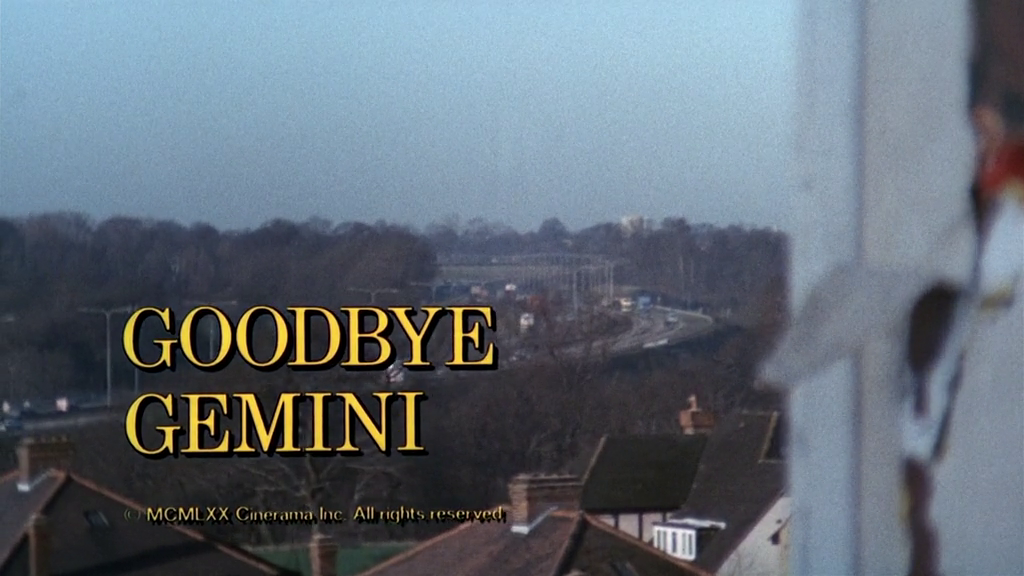
Two for sorrow… Goodbye Gemini (1970)

This film is one of those late sixties treats served up with fascinating locations and post-psychedelic style and making the most of the increasing laxity of censorship and the decriminalisation of homosexuality with The Sexual Offences Act 1967. It’s a huge variety bag of richly-flavoured chocolates that leaves you feeling a little queasy by the end and that was probably the intention; folk on IMBD have mixed feelings about it but it’s got a fabulous cast and something to say as it ticks off the boxes of incest, transvestism, queer culture and deep psychological disorder.


Sixties It Girl supreme Judy Geeson gives one of her best performances in my opinion playing against type as the firm-willed and more grounded of a pair of twins at the heart of the action. Many times Judy was required to play ultra-pretty and very sweet, which she excelled at, but here her job is not to be likeable but to illustrate how relationships of damaging inter-reliance and child-like intensity can persist in the real world. Not for nothing was this film retitled Twinsanity (yuck) for a rerelease, as Judy is Jacki, sibling to Julian, and together they present what looks like easy pickings for London’s swinging hipsters but, as Jacki keeps on saying, they can look after themselves.

Judy Geeson

The psychopathic Yang to Jacki’s Yin is played by Martin Potter, rolling straight off the back of his startling turn in Fellini’s Satyricon (1969) into a world only slightly stranger. The last time I saw Mr Potter he was playing in the real world as a policeman mixing with the wrong crowd in All Coppers Are… (1971) and here he shows once again how he can be an unsettling presence, a febrile performer whose eyes give everything and nothing away. Whilst Judy presents as fun-loving and ultimately sound of mind, Martin gives only nervy uncertainty. This is true of his obviously inappropriate – and illegal – feelings for his sister, but we just don’t know what he is capable of doing.


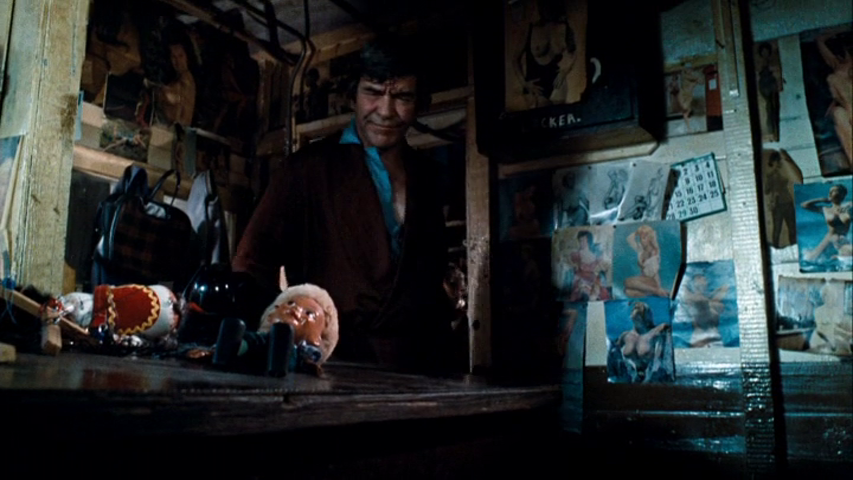
The twins arrive in the capital from the west country by coach, snaking along the Westway/M4 and making their way to a flat in Cheyne Walk with a fine view of the Chelsea north bank, power station still smoking. We are given an immediate indication of their wayward sense of purpose when they take out their disapproving landlady by placing their treasured toy cat, Agamemnon on the top stair so that she trips and falls as they run from the building, alibi intact. They defer to Agamemnon in all important decisions (the film is based on the novel, Ask Agamemnon by Jenni Hall), a reflection of their childish intimacies but also unhinged morality: they happily let the toy make their choices.

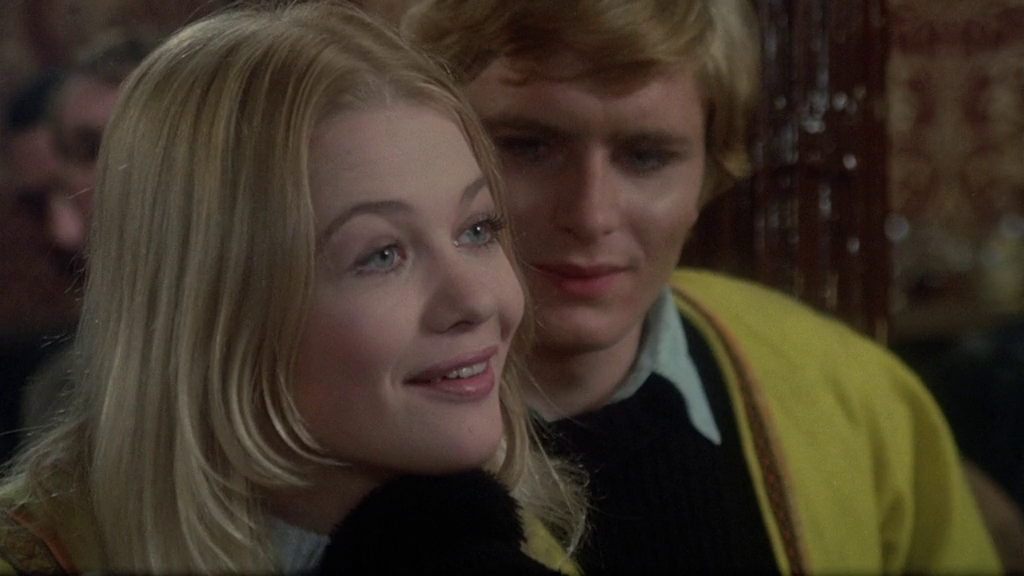
Judy Geeson and Martin Potter, playing an attentive brother...

Another actor whose eyes give away unsettling possibilities is Alexis Kanner, a French born Canadian actor of no fixed accent here but who displays his usual twisted energies as deployed so effectively in The Prisoner, Connecting Rooms (1970) and elsewhere. Kanner plays hipster gadabout Clive Landseer who meets the twins in a crowded bar watching a drag show at the Royal Vauxhall Tavern (plus ca change eh?) and pulls them into his sleezy world of free-flowing sexuality, non-stop partying and general debauchery. He focuses attention on Jacki and tries to hand over his friend Denise (Marion Diamond) to Julian who looks on in panic at Jacqui’s removal from his side.


Clive invites them to his friend’s river boat for a party, here we find all manner of louche characters, including a smartly dressed Freddie Jones as David Curry, watching the action from a hammock, as the twins arrive and cause a stir as Jacki dances with Clive and Julian stares daggers. Much to Denise’s upset he soon cuts in and the whole room looks on in shock or groovy approval as the siblings get very close.

Mike and Fred

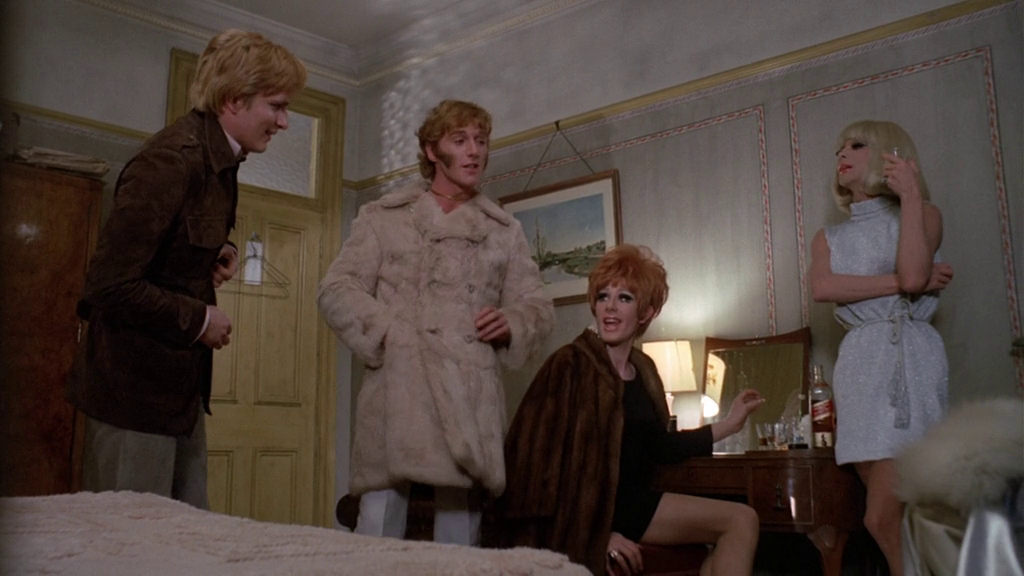
An MP arrives, James Harrington-Smith (Michael Redgrave always a class act even struggling with the early onset of Parkinson’s) who discusses art with an impressed Jacki as, again, Julian looks on with desperation. The twins leave spurred on by Julian’s increasing anxiety and are accompanied by Clive and Denise as whiskey is drunk and arguments are had at the twins’ flat. Clive decides to tackle the main issue by getting Julian to accompany him on an adventure, plying him with more drink and phoning ahead to arrange a special entertainment at a seedy hotel. Staggering into room 104 Julian’s eyes light up as he sees two dolly birds in miniskirts… by the time he realises that they’re boys, not girls, it’s too late and the camera cuts as in his shock he is overwhelmed by the, um, circumstances.


The next morning Julian recovers his poise back in the reassuring presence of his sister but this will not be the last he hears of this night. Clive has been dodging his bookie, Rod (the ace Mike Pratt) who previously came looking for him at the boat party, promising him a beating as an incentive to pay up on his accumulating debt. Rod had visited the flat the night before finding only the two women and when Clive visits Jacki later in the day, he corners him and makes his point; a couple of body blows as a taster for the retribution to come.

Here come the girls...

Clive is in some spot and almost reluctantly, decides the only way is to blackmail Julian to get the money, presenting him with a collection of photographs depicting the previous night’s entertainment. The only trouble is Julian doesn’t have the money and the only trouble for Clive is, you don’t take on one of the twins without taking them both on and, as Jacki has always pointed out… they can look after themselves.


The stage is set for a traumatic closing segment in which both Judy and Martin perform superbly as does Redgrave in what appeared to be a bit part.


Dusty Verdict: Not a film you watch for pure enjoyment or nostalgia, there are some real points to make and a dedication to the uncomfortable realities behind the rapidly fading myths of sixties hedonism. As I’ve said, the actors are all on form and I really think this is one of Judy G’s most interesting portrayals.


The mood has been said to be uneven but director Alan Gibson is just showing the push and pull of reality versus the twin’s world, an unreality dominated not so much by the obsessive sociopathic Julian but the character they project into Agamemnon the cat.