Showing posts with label Susan Hampshire. Show all posts

Saturday, 30 May 2015

Jersey mystery… Neither the Sea Nor the Sand (1972)


This strangely affecting film is an ode to enduring love which just happens to have been based on a book by the TV newsreader Gordon Honeycombe. It is based on Jersey, an island I know reasonably well, and the setting alone guarantees an atmosphere of dislocation: an isolated lighthouse on the wind-battered North side of the island and the unpredictable tides off Five Mile Beach provide an uncompromising backdrop to this curious love story.

Honeycombe wrote the screenplay but eventually fell out with the film’s producers and as I haven’t read his original story I can’t work out why. Any adaptation takes on a life of its own and it can’t be easy being the author especially when you know a few tricks of the visual trade.

Michael Petrovitch and Susan Hampshire
Susan Hampshire stars, apparently by her own insistence, and shows what a fine dramatic actress she is – a world away from the upper class roles she has sometimes been associated with. She’s highly watchable throughout and plays to the supernatural McGuffin with conviction: she has to as the whole story rests on it.


Her Anna Robinson is a woman whose relationship has just broken up and who has come to Jersey to think out her future direction. During one of her sad solo walks she encounters a tallish dark handsome stranger near Corbiere Lighthouse - Hugh Dabernon (Michael Petrovitch). He tells her of the dangers of the tides that rips over the small causeway linking the lighthouse to the shore and they walk back to the shore together.


They couple agree to meet again and start to discover each other, walking the streets of St Helier and watching movies: comparing notes on their lives, Eventually they go back to his place encounter his even odder older brother George (Frank Finlay) who doesn’t like the idea of any fancy woman attracting his brother or something like that. The two are steeped in Jersey mystery… being one of the oldest families on the island with a brass rubbing of a mediaeval knight bearing an uncanny resemblance to Hugh…

Brother George leads the dinner discussion
Anna and Hugh grow closer and a romance begins with some obligatory period nudity that I suspect was not in Miss Hampshire’s contract. The couple head off to Scotland to stay at the well-appointed Dabernon home-from-home yet tragedy strikes as they take a walk on the beach: Anna turns round to find Hugh face down on the ground, unnaturally still. In a panic she flees to the house and gets the housekeepers to call for help.

The doctor duly arrives and pronounces Hugh dead leaving Anna devastated… She returns to the old house and cannot sleep; wandering around the house in the dead of night, hearing noises and despairing at the loss of this chance of love when she had least expected it.

This never happened in my movies with Cliff...
She sees a figure moving outside, getting closer to the house… seemingly waiting for something or someone. She opens the door to find Hugh miraculously re-animated and apparently alive only he’s not exactly saying much just staring.

She returns to Jersey with Hugh in tow and goes to his house. Brother George is not impressed by any aspect of recent development and concludes quickly that his brother, much though he would like him otherwise, is dead. Somehow he has been kept alive by Anna’s desperate love and George tells her she must let go.


But Anna cannot think beyond her returned love and the half-dead Hugh runs his brother off the road sending him to his doom. Now it is just the two of them left with Hugh’s increasingly cold flesh pushing their spirits slowly apart.

A friendly local lad Collie (Michael Craze, who viewers might remember as assistant to both William Hartnell and Patrick Troughton), takes an interest in Anna and tries to find out if she is alright but she tries to push him away.

Michael Craze second from the right
As Hugh becomes more distant, Anna must decide what to do with her love: can she really let it go or is there a way she can push through into eternity..?

Dusty verdict: Directed by Fred Burnley, Neither the Sea Nor the Sand is an efficient chiller which raises questions about the nature of grief whilst also holding out for love. Should Anna simply move on or are some relationships binding for all time: has she even a choice in the matter?


The film retains an eerie quality and the atmosphere lingers perhaps due to the eternally-close proximity of Love and Death…

Michael Petrovitch and Frank Findley make for excellent siblings, the latter assuming the role of repressed “Parent” to his much younger brother’s determined individualism. How this connects with later events is open to debate, maybe their land-anchored heritage plays a role in Hugh’s transformation? Or maybe it’s just the love of a very good woman.

Susan Hampshire
Susan Hampshire is excellent as the vulnerable city-soul who finds herself in the cold isolation of the Jersey shore, with her delicate confusion becoming replaced by the vice-like grip of her love for Hugh and the realisation that she cannot live without him…

Neither the Sea Nor the Sand is available on Odeon Entertainment either direct (DVD or download) or from Amazon.

Sunday, 3 November 2013

Soho sweet and sour… Expresso Bongo (1959)


A dip into the late fifties by way of comparison with Beat Girl… this film features a teenage Cliff Richard but still manages to carry enough Frith Street grit and Denmark Street guile to evoke the spirit of Soho. Setting all else aside, the film's use of genuine locations literally grounds its potential cheese in the shops, clubs and coffee bars that give Soho its timeless air: facia may come and go but the grind goes on forever... timeless good times.

Lisa Peake and Laurence Harvey
Based on the successful stage play of the same name and initially intended to feature one Tommy Steel taking side-swipes at the industry that birthed and abused him, it eventually featured the hotter, younger Harry Webb from Cheshunt, near Enfield. Just as Harry got a name change to Cliff so does his would be drummer, Bert Rudge, get re-branded as Bongo Herbert in this film: anyone doubting Expresso Bongo’s intent should check the surname…

Cliff Richard
There’s a wonderful cameo from Susan Hampshire playing a golly-gosh deb besotted with Bongo: “go on, say something in Cockney, apples and pears or something…” she pleads, sounding almost like Armstrong and Miller’s cut-glass chavy pilots…  This is the British laughing at themselves and joking about how easily they’re fooled, yet there’s also a harsher edge that ultimately leaves the successful on the slide and those on their uppers on the up.

Johnny extends credit to Kakky
Laurence Harvey uses his considerable skills to create a thoroughly dislike-able agent and serial abusers of goodwill: Johnny Jackson. We see him working his way down a Soho Street palming his best wishes to all whilst delaying his debts and wisecracking his way to nowhere… networking is only a payday away form not-working. He has a soft-spot for old man Kakky (Martin Miller) a former director... is he a vision of Johnny's future?

Sylvia on stage
His long-suffering girlfriend Maise, the sublime Sylvia Syms,  can sing and dance a bit (not enough for Johnny) and we see her do a rather risqué number at a “gentlemen’s club” surrounded by barely dressed chorus girls and the famed frozen semi-naked tableaux that allowed the strip clubs to avoid censure… It was a particularly British form of censure: allowing a view of naked flesh that was only permitted if it was motionless as if that somehow made it less real, less… overt. Only a public-school educated judiciary could work out the logic in that one.

It's "educational" so long as they don't move...
Never-the-less, this scene is still fairly frank for the time with scant coverings for the artistes and Miss Syms in the most revealing of costumes… Maybe the film’s musical status enabled them to treat this all in a jokier context than say the uncut version of Beat Girl?


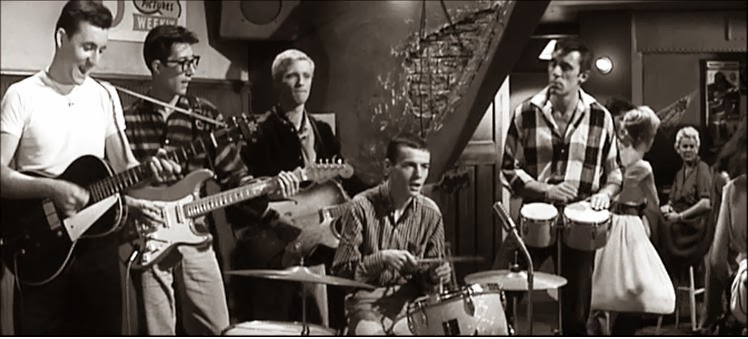
Anyway, soon enough the action moves to a suspiciously-spacious coffee bar basement where cheap-skate Johnny is taking Maise for some fish and chips. Their evening is cut short though when Johnny hears Bert sing as he "plays" his bongos backed by Hank Marvin, Bruce Welch, Jet Harris and Tony Meehan aka The Shadows (I’ve tried hard but can’t quite get the sound to sync with Cliff’s movements… by “hard”, I mean once…). In spite of Bert’s protestations that he wants to be a drummer (can’t he see The Shadows have already got a decent percussionist?) Johnny insists he can be a pop singer and that's the last we hear of Cliff's bongos...

Bruce, Hank, Jet and Tony... actor Barry Lowe on bongos
Cliff is ridiculously young but what catches the ear is how much reverb young Hank is using on his guitar, they sound a bit more rock n roll than they’re given credit for!

The newly christened Bongo meets Johnny at his parent’s flat and, in spite of motherly indifference and fatherly drunken stupor, a deal is struck and Bongo signs a contract splitting everything 50:50…

Hermione Baddeley, Lawrence Harvey and Cliff
Johnny kicks into gear and begins to hype his new property; jumping a ride on anything he can to increase his profile. He hi-jacks a BBC documentary being made by the actual Gilbert Harding, on Soho youth, to show off Bongo’s singing and then works his way onto the broadcaster's show to shout down the analysis of a pompous psychiatrist (Patrick Cargill) and a wet priest (Reginald Beckwith).

Denmark Street, London's actual "Tin Pan Alley"
Johnny suckers in the boss of Warwick Records, Mr Mayer (Meier Tzelniker), getting Maise to make a call there, pretending to be from HMV and Bongo’s debut single is soon shooting up the charts.

But Johnny’s biggest twist comes in forcing Bongo on the stage alongside Dixie (Yolande Donlan – director  Val Guest’s wife) for her triumphant UK comeback gig at the Dominion Theatre in Tottenham Court Road. He’s a smash and it’s not only Johnny that sees a way of hitching a ride on his rising star.

Cliff, speedos and Yolande Donlan
Dixie’s soon being more than motherly with Bongo luring him to her penthouse apartment atop the Dorchester Hotel – cue the shots of Cliff in speedos that were such an influence on a young and impressionable David Hockney.

But Dixie cares about the kid and especially his rotten contract and it’s dog eat jackal over the closing sequences as everyone fights over the spoils. In the end, you’ve pretty much given up hope for anyone in this sordid world but defeat brings out the best in some and a chance emerges for the film’s most likable and long suffering character…

The battle for Bongo
This uneven film interests and irritates in equal measure but has some good characters and dialogue – “I recognise the face but not the flattery” says Dixie to the ingratiating Johnny.  Harvey is good as the over-bearing huckster and has more than a passing resemblance to Jude Law; he went on to major film stardom and had an edge.

Sublime Sylvia
Sylvia Syms also excels in one of her patiently trusting roles: she’s said it herself but she didn’t always have good or lucky marriages in her films of this period. 

Mr Harvey on screen
Cliff is still learning the ropes but passes muster playing someone not unlike himself. More anodyne fare was to follow and here his role is earthed rather more than in Summer Holiday. Odd that his character appears to be pretty much a virgin, there’s no real love interest other than the motherly-predatory Dixie and religion is introduced as a way of selling a better image (a move I would guess he was later very embarrassed by).

"Go on, say something Cockney..."
There are also glimpse and you’ll miss them cameos from Burt Kwok and the aforementioned Susan Hampshire who would play alongside Cliff in Wonderful Life.

But this doesn’t feel like a “Cliff film” but a twisted ode to the dysfunctional pop business filmed in the streets at its very heart. In the end my star of this film would be London and in particular the surrounds of Soho as old as William Blake and alive still with the spirit of mischief.

Martin Miller, Sylvia Syms and Laurence Harvey
Dusty verdict: Worth watching just to street spot but Harvey and Sims make a good couple and you also have the young Shadows rocking in a way that convinced even Neil Young that they were cool! Beat Girl has the edge though if only for John Barry’s incendiary soundtrack, but the Soho scenes work better than the showbiz second half.

You can buy the DVD on Amazon but it's a bit of a collector's item thanks to the enduring appeal of Mr Harry Webb.
That is Wolf Mankowitz carrying the placard down Hanway Street...
Old man Kakky admires the artistes
Gilbert Harding plays himself