Showing posts with label Michael Caine. Show all posts

Sunday, 28 June 2020

Public interest? Passport to Shame (1958)


It’s all here! Nothing hidden… neither the sin… nor the shame!  Actually torn from the pages if the nation’s leading newspapers!

So screamed the American poster for this film and yet there’s more to it than box-ticking sexploitation. There’s an introduction from Robert Fabian, aka ‘Fabian of the Yard’, at the start, which makes it clear that it’s for public information not titillation; this is a film to show the horrors of sex work and the tragedies that fuel it and result from it. Frankly, I believed him – although this is the same public interest argument used by the News of the World – yet I’m sure that the filmmakers were sincere, especially given the quality of the cast, Brenda De Banzie, Herbert Lom and Eddie Constantine were not cheap or short of work. But there is also very little besides the high-octane sexuality of Diana Dors that you could class as salacious and, the thing is, Diana can also act, she’s a knockout and stands out among a quality cast.

The film’s story is also not to be belittled that easily – you can call it trite but the fact remains that people then and now have become trapped into prostitution and it is not the glamorous career of the sexually free but slave work operated by ruthless “business men”. The film hits as hard as it reasonably could in 1958 and is still entertaining, which is a good thing as it’s just been released on crystal clear Blu-ray.

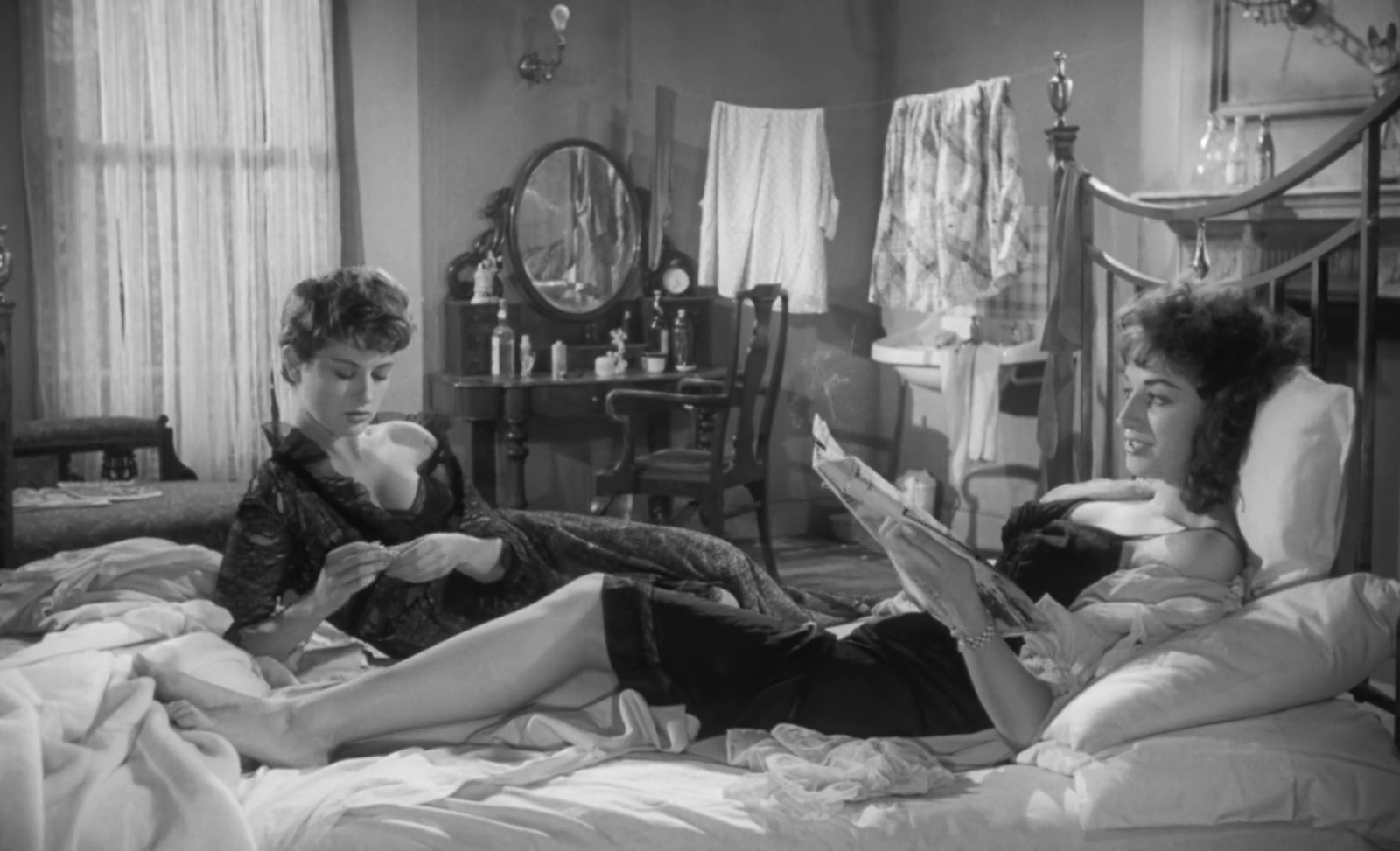
Odile Versois and Diana Dors waiting for the men...
I like the cleverness of the opening as those newspaper headlines are blown into the gutter in a busy London street where the camera moves quickly from person to person as littel scenarios are palyed out. A man sees a sgtunning blonde and follows up her body only to realise she's a streetwalker then he walks over to anothe man who is staring at a new taxi cab he is desperate to buy... a great way to introduce people who will become key characters as the titles roll.

Directed by Alvin Rakoff – his first film after working mostly on TV – the film is centred on the “business” operation of low-life crook with big ideas, Nick Biaggi (Herbert Lom, who always delivers, whatever the script). Biaggi’s little empire is based on extortion and pushing people into having to pay him back in kind for debts he creates. In Paris where a young waitress, Marie Louise 'Malou' Beaucaire (Odile Versois) is entraped by Nick's his right-hand woman, Aggie (the excellent Brenda De Banzie).

Malou (Odile Versois) looks on in horror as Aggie (Brenda De Banzie) "saves" her
She has the café owner take money from the till and accuse Malouf of stealing it as Aggie slips the same amount into her apron. She’s facing prosecution and so readily accepts Aggie’s seemingly generous assistance and the chance to come and stay with her in London.

Meanwhile, Johnny McVey (Eddie Constantine), a former Canadian soldier working as a cabby in London takes a loan from Nick’s company in order to buy himself a black cab, he’s stretched to the limit but he’s determined to make a success of the trade. On his first day with the new motor, just as he’s being congratulated by the tight-nit group of fellow black cab drivers, Nick arranges for his lads to drive a truck into the new cab, crushing the front and Johnny’s plans.

A friend in need? Lom and Constantine.
Nick is on hand though to play the nice guy and to offer to cover the cost of repair knowing that Johnny now owes him more than money, and that’s a big favour. That favour will be to marry Malou so she can get her citizenship. She’s been moved into Aggie’s apartment which, according to Reel Streets is Courtfield Gardens between Earl's Court and Gloucester Road in southwest London. Aggie’s rooms adjoin the neighbouring house, which is a brothel full of working women, one of whom is played by Jackie Collins, Joan’s sister.

Also to be found is Vicki (Diana Dors), Nick’s top earner and a woman resolute in the face of her situation and Nick’s violent treatment of her sister. Dors is striking in all the right ways and conveys the defiance of someone who knows what it’s like to be objectified and also manipulated. Her character’s sister has been the lever Nick has used to keep her working and she has been disfigured, forcing Vicki to carry on working for the man she so despises, to cover medical bills. For all the almost light-heartedness of the “girls” in the cat house, Dors’ intensity does more than anything else to ground this in a – dramatized – reality.

Diana Dors
Elsewhere you sense a fairy tale in the making as Malou and Jeff meet and go through the motions of marriage to settle their debt – or at least the first instalment of Nick’s unforgiving contract. Also present at the registry office is one Michael Caine who has just got married to one Anne Reid – uncredited bit parts for two actors who have never stopped working since.

Returning to our Johnny and Malou, the marriage may be fake but not perhaps their nascent relationship. But there’s a torture path to follow before anything can come from this as Malou finally realises what is intended for her and Nick pressures her to start paying him in kind on the streets of West London and to set herself up in Room 43 – the alternate title in the UK for this film. He has high hopes and sees her breaking him into the next level of high-class escorting but she wants none of it and refuses even though it increasingly means that she is not only surplus to requirements, she’s an problem in need of a drastic solution.

A marriage of convenience?
Robert Brown does well as Mike, Johnny’s friend who initially looks down on his relationship with what he sees as a common prostitute but, as the audience is intended to, he gradually comes round, especially as he befriends Vicki and realises there’s some heart underneath the figure hugging, peroxide display.

But there is to be no easy way out for these characters and the film escalates in tension as escapes fail, threats ae made and the ultimate penalty is going to have to be paid for some…


Dusty verdict: I gave this film the benefit of the doubt and it repaid me with some excellent dramatics from a decent cast. The locations are also worth it, parts of London where the only change in 60-odd years has been the frequency of external decoration and the tax-bracket of the inhabitants.

There’s also a heart-warming cameo from Joan Sims as Miriam, Phone operator in the taxi office and one Nicolas Roeg was the camera operator; he later went on to direct Don’t Look Now and many other modern classics. Passport to Shame is not on that level but, now, as a social document of the way this subject was viewed in my parents’ era, it is worth your time.

You can buy the Blu-ray at Amazon and all good on and offline retailers.

Fabian of the Yard
Mike bumps into Vicki during the film's credits and only comes to know her proper worth later
Johnny and Malou's dreams are revealed during the credits...
Nick is the one to use their hopes against them.
Still, he at least drives and Aston Martin
Lovely couple: Michael Caine and Anne Reid

Saturday, 5 October 2013

Sour times… The Ipcress File (1965)


There was a moment listening to John Barry’s splendidly expressive and inventive score to The Ipcress File, when I realised that Portishead had sampled it or at least borrowed its sound and spirit.

I shouldn’t be surprised as the downbeat disconnections of Sidney J. Furie’s, distinctly un-swinging, 60’s spy film fit perfectly with the off-kilter beats of the Bristol miserablists (well… they are splendidly thoughtful). As with Portishead, this film looks for the more difficult narratives that often lurk just out of sight. It’s the height of the 60s, spies are cool, they have gadgets, girls and guns but they also have mundane sadness, confusion and everyday betrayals alongside the quirks and cruelties of the trade.

A modern spy...

Len Deighton’s Harry Palmer was created not so much as the anti-Bond but his more believable cousin. Harry has a way with the ladies, is pretty smart but he isn’t that polished: things happen to him and he reacts… Harry’s just about keeping up whereas James’ is always one step ahead.

Michael Caine makes for the perfect screen Palmer, a former criminal who now makes real coffee and cooks cordon bleu in the kitchen of his small flat in Formosa Street, Maida Vale. Harry’s game involves lots of investigation and patience – it’s a proper procedural with even the more obviously-dramatic moments down-played in a way that makes them somehow more credible. His gambles don’t always pay off in the boys own way of Bond, but he’s a non-conformist and his rough-edged intuition may just be what can save the day.

Michael Caine and Nigel Green

The film’s backdrop is the grime of a car-choked London barely recovered from the Luftwaffe’s beating… not a yacht in sight, but all the better for it.

At the film’s start, Harry is lifted from slow-moving surveillance to help investigate the mysterious disappearance of a British scientist. There’s an abnormal brain drain with a succession of leading British boffins packing it in for unknown reasons and this is just the latest in a series of unfortunate events.

Officer's club: Nigel Green and Guy Doleman
Harry is regarded with scorn by true blue Colonel Ross (Guy Doleman) who gladly hands him over to Major Dalby (Nigel Green) who seems less than thrilled. It’s not a red letter day for Harry either as there’s only the promise of a small pay rise to go with this change of duty.

Harry meets his new team who include Carswell (Gordon Jackson) and Jean Courtney (Sue Lloyd) - Furie’s direction is so downbeat and knowing he’s not going to signal any obvious intentions with these or any other characters. Never-the-less, Carswell quickly becomes and ally for Harry whilst Jean responds to his less than suave overtures to come to his flat for dinner.

Sue Lloyd
Clearly, nothing is that clear and you really can’t trust anyone in this business or rather, can’t really be sure of who not to trust. And through all of this there’s an undercurrent of class prejudice as the natural officers struggle to impose themselves on the uppity rank and file.

Harry gradually begins to make headway, locating one of the likely kidnappers, Grantby - codenamed Bluejay (Frank Gatliff), and his lieutenant Housemartin (Oliver MacGreevy).  He follows Grantby into a library near the Albert Hall (The Science Museum Library) and calls a number Grantby given which proves to be false. The camera is close-up on Harry’s face but as he leaves the phone box, the camera view remains through the windows as Harry engages Housemartin in hand-to-hand combat. It’s typical of the film’s understated edge and we see that Palmer can handle himself, even though the birds manage to fly away…

Harry's eye-view
Playing a hunch, Harry orders a raid on a warehouse but finds nothing other than a strange tape… it’s scant consolation but buys him a little time. Played back the tape emits atonal noise and it’s unclear what this means… on it is written the word Ipcress.

Eventually Dr Radcliffe (Aubrey Richards) is returned in exchange for a payment but in the chaos immediately after the swap; Harry succeeds in shooting an American spy…


 Things speed up as Radcliff turns out to have been brain-washed and cannot function as a scientist. Then Caldwell makes the connection that will explain what Ipcress really means and people start dying, from another American sent to spy on Harry to Caldwell himself who is shot waiting at traffic lights in a very grimy Upper Thames Street…

Dirty old town
Harry realises he is being set up and following Dalby’s advice to make himself scarce, boards a train for Paris… but the enemy, whoever they may be, are already ahead of him.

Up till this point the film plays its cards reasonably close to its chest and is a novelty of surprises set against Bond-ian preconceptions. The closing third of the film sees a shift towards more typical action albeit with the focus firmly on the psychological…with a twist or two I won’t reveal. Harry has to pull himself together against all odds… to decide who to trust and, in the end, who to kill.


It’s all done grubbily well and Caine is, of course, superb: an actor who always holds enough back to pull the watcher in – he’s that uncertain hero we all hope to be. Nigel Green is another performer who smuggles a lot of meaning under an intense gaze and snarling stiff upper lip as does Guy Doleman albeit with rather more disdain.

Barry’s score flavours the film with enigmatic flourishes that takes turns in revealing narrative intentions with the actors, from Harry’s early morning coffee grinding to more clearly dramatic moments. He must have enjoyed the chance to show more compositional subtlety.


His score also works well with Furie’s angular direction and Otto Heller’s cinematography: through low and off-kilter angles, they create a world of disquiet even in the sparse, emotionally-empty rooms of the secret service. These high ceiling-ed imperial left-overs reflect the under-funded and shabby British service, still recovering from the War twenty years before. In the corner next to Colonel Ross’ desk, is a rickety camp-bed: needs must…it's one of the film's many telling details.


Dusty verdict: There’s a shift in Barry’s score during the meeting with Granby, when questing flute themes are pierced by the spidery sound of piano strings being plucked, the brass section builds the tension and then suddenly there’s a pause, deep piano chords and an eerie distorted guitar line repeats and repeats sending shivers of dread anticipation through the viewer… something is very wrong.

Gordon Jackson and Michael Caine
No Aston Martins but at least Major Dalby drives and MG